The Constitutional Review Committee has presented its report to President John Dramani Mahama after months of engagement with the Ghanaian public and key stakeholders.
The committee, chaired by Professor Kwasi Prempeh, has proposed a number of amendments to Ghana’s 1992 Constitution aimed at strengthening governance, promoting citizen participation, and addressing key national issues.
Here are some key highlights from the committee’s report;
Constitutional Review Committee proposes five-year Presidential term
Five-year presidential term
One of the key proposals from the committee is the extension of Ghana’s presidential term from four to five years.
The committee argued that the current tenure does not allow sufficient time for governments to effectively implement policies, emphasising that the proposal is intended to enhance governance efficiency and deliberately excludes any provision for a third term.
Cap on ministerial appointments
The committee also proposed the imposition of strict limits on the size of government, recommending amendments to Article 78(2) to significantly reduce its size.
Under the proposal, the total number of Ministers of State, including Deputy Ministers and Regional Ministers, would not exceed three times the number of Cabinet Ministers.
With the Constitution already capping Cabinet Ministers at 19 under Article 76(1), the total number of ministers across all categories would therefore be limited to 57.
An end to MP-to-minister appointments
The committee has proposed an amendment to Article 78(1) would prohibit any sitting Member of Parliament from being appointed as a Minister of State, Deputy Minister, or Regional Minister.
The committee further proposed that any Member of Parliament who resigns from Parliament would be ineligible for ministerial appointment, with the restriction applying only for the remainder of the parliamentary term for which the individual was elected.
Reduce presidential age limit from 40 to 30 years
Another recommendation involves reducing the minimum age required to contest the presidency from 40 years to 30 years.
The committee argued that amending Article 62(b) of the Constitution to allow younger citizens to contest the highest political office in the country would remove age-based barriers that limit access to leadership opportunities.
Cap on Supreme Court judges
The committee proposed that the Supreme Court should be composed of the Chief Justice and no more than 14 other justices, totaling 15.
This would require an amendment to Article 128(1) of the 1992 Constitution to formally set an upper limit on the size of the Supreme Court.
This is however aimed at streamlining the appellate jurisdiction of the Supreme Court in order to reduce its workload and improve efficiency in the administration of justice.
10-year non-renewable term for EC boss, deputies
Another key proposal is an amendment to Article 223 of the 1992 Constitution to provide that the Commissioner and each Deputy Commissioner of the Electoral Commission shall hold office for a single, non-renewable term of 10 years or until attaining the age of 65, whichever comes first.
The committee recommended that former Commissioners and Deputy Commissioners be barred from holding any other public office for three years after leaving their positions.
A sole anti-corruption commission
The committee also proposed the creation and establishment of a standalone Ethics and Anti-Corruption Commission aimed at rationalising the roles of existing anti-corruption institutions and improving efficiency in the fight against corruption.
The proposed commission would consolidate anti-corruption responsibilities currently spread across bodies such as the Commission on Human Rights and Administrative Justice (CHRAJ), the Office of the Special Prosecutor (OSP), and related institutions, to ensure better coordination and clearer accountability.
Tax on presidential emoluments
The Committee also suggested amendments to Article 68(5) to ensure that the salary, allowances, and facilities enjoyed by the President are subject to taxation, in line with applicable tax laws.
Under the proposal, the President would also be required to pay indirect taxes on goods and services, including import duties, on the same basis as all other citizens.
Constitution Review Committee report to be implemented in bipartisan manner – President Mahama
“The Committee recommends an amendment to clauses (1) and (2) of Article 71 to provide that the salaries and allowances and the facilities and privileges available to persons holding public office generally, including the President and the holders of the other offices listed under clauses (1) and (2), shall be determined by the proposed Independent Public Emoluments Commission,” he stated.
Council of state reforms
The Committee proposed a return to its original structure as envisioned under the 1969 Constitution.
MAG/EB
Meanwhile watch highlights of Black Sherif's performance at Zaama Disco 2025
General News of Tuesday, 23 December 2025
Source: www.ghanaweb.com
Key highlights of proposed amendments in 1992 Constitutional Review Committee report
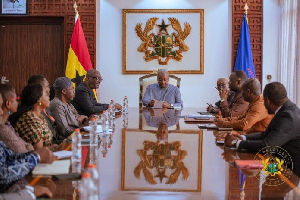 President John Mahama and some members of the Constitutional Review Committee