The Ghana Rice Production Improvement Project (GRIP), led by the Japan International Cooperation Agency (JICA) in partnership with the Ministry of Food and Agriculture (MoFA), has taken a bold step toward transforming rice production in Ghana.
A landmark field demonstration at the Kpong Irrigation Scheme introduced labour-saving technologies designed to reduce production costs and address labour shortages that have long undermined the competitiveness of locally produced rice.
Ghana currently imports close to 950,000 tons of rice each year, with Asian varieties dominating the market due to their lower production costs.
Local farmers face steep challenges, including rising machinery service fees for ploughing and harvesting, as well as a shortage of labour as many young people migrate to other sectors of the economy.
The heavy reliance on manual labour for ploughing, seeding, fertilizing, harvesting, and drying has driven up production costs, leaving Ghanaian rice priced at levels similar to or even higher than imported rice.
This situation has frustrated both producers and consumers and weakened the country’s push for rice self-sufficiency.
Government to roll out 3 major VAT reforms in 2026 - Dr Ato Forsont
To tackle these constraints, GRIP has championed the integration of modern mechanisation as a strategic solution. At the demonstration, rice stakeholders were introduced to advanced equipment such as dry-field direct seeders, no-till dry-field direct seeders, wet-field direct seeders, drone seeders, and drive harrows.
These technologies are expected to simplify land development, reduce intensive preparation, improve soil levelling, and shorten manual labour operations.
They also promise to enhance post-harvest efficiency, improving the overall quality of rice. A key highlight was the unveiling of a flat-bed paddy dryer, designed by the International Rice Research Institute (IRRI) and fabricated locally in Ghana.
This dryer offers a labour and time-saving alternative to the traditional practice of drying paddy on outdoor flat floors after harvest.
This collaboration between manufacturers and dealers is expected to accelerate the spread of mechanisation across rice-growing regions and encourage the development of new business models that make these technologies accessible to farmers nationwide.
Also, watch below Amnesty International's 'Protect the Protest' documentary as the world marks International Human Rights Day 2025
SA
Business News of Wednesday, 10 December 2025
Source: www.ghanaweb.com
JICA, Agric Ministry pioneer mechanisation to cut costs in Ghana’s rice sector
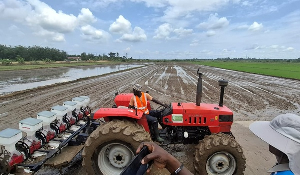 Local farmers face steep challenges, including rising machinery service fees