Regional News of Monday, 9 March 2026
Source: www.ghanaweb.com
World Engineering Day: UMaT showcases home-grown engineering innovations

Correspondence from the Western Region
The University of Mines and Technology (UMaT) has highlighted a number of innovative engineering solutions developed by its students and researchers, demonstrating the growing role of technology in solving real-world problems.
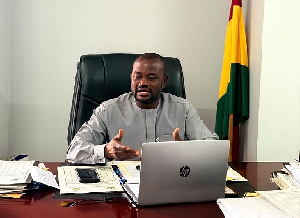
The projects were showcased during a symposium organised by the university to mark World Engineering Day for Sustainable Development, where the Head of the Computer Science and Engineering Department, Dr Emmanuel Effah, outlined several practical technologies developed on campus.
Among the innovations is a smart irrigation system that allows farmers to monitor farm conditions and control irrigation remotely using a mobile phone.
The system collects data from sensors on farms and transmits the information to the cloud, enabling farmers to trigger irrigation from anywhere in the world.
According to Dr Effah, the technology has already attracted international attention and was presented at a technology event in Belgium. Two countries—Burkina Faso and Senegal—have since adopted the system.
He noted that when the technology was deployed in Burkina Faso, the irrigation system was remotely controlled from UMaT in Tarkwa.
In the area of assistive technology, the university has also developed an intelligent electric wheelchair capable of responding to voice commands.
Users can instruct the wheelchair to move to locations such as the washroom or kitchen, enabling greater independence for persons with mobility challenges.
The wheelchair was exhibited at the Accra International Conference Centre where it received several awards.
UMaT students have also built a prototype electric vehicle using mainly scrap metal and locally sourced materials.
The vehicle, supervised by university engineers, demonstrates the institution’s growing capacity in electric mobility and sustainable transport solutions.
Dr Effah further revealed that the university has developed real-time environmental monitoring technologies, including devices that measure air quality and water quality using sensors connected to cloud-based platforms.
The water quality monitoring technology has already been deployed by AngloGold Ashanti to monitor aquaculture operations.
According to the university, the system helped eliminate fish losses over a six-month monitoring period after previously recording significant monthly losses.
Other projects exhibited include smart home automation systems such as clap-controlled and voice-activated switches, a solar-powered refrigerator designed to preserve medicines in off-grid communities, drones assembled by students, and smart waste bins that alert users when they are full.
Dr Effah said the innovations reflect the university’s commitment to practical engineering and student-driven research.
He noted that many of the technologies were developed by students working with faculty members in campus laboratories, adding that some of the innovations have already won international recognition at global innovation fairs.
The university has called for greater attention to engineering education and innovation, stressing that technology development remains key to solving many of the continent’s challenges.