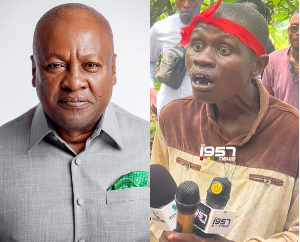
President John Dramani Mahama has reacted to a viral video of a cocoa farmer who claimed, “Mahama wo de yɛ ka,” to wit, “Mahama, you owe us a debt.”
The said farmer, in the viral video, was among many aggrieved cocoa farmers who were protesting against the falling cocoa beans prices during an engagement with the Minority Caucus in Parliament in the Ashanti Region.
Ivory Coast cocoa producers suffer amid global price fall
Given the platform to speak, the farmer, clad in a red cloth tied around his head as a symbol of protest, called out to the president, insisting that he owes them a huge debt.
According to him, President Mahama has failed to honour campaign promises to increase cocoa prices, insisting that the president “owes” farmers after pledging, while in opposition, to raise the price from GH¢31 million to about GH¢60 million, a promise he claims influenced their decision to vote for him.
“If President Mahama were here, I would ask him to listen carefully. Mahama, listen to this message: you owe us a debt. Whether you like it or not, you owe us. Before the elections, cocoa farmers were receiving GH¢31 million, but Mahama, while in opposition, said the amount was too small. He even promised that if voted into office, he would increase the cocoa price to about GH¢60 million. On that basis, we voted for him,” he said in the video.
Reacting to the video, President John Dramani Mahama jovially mimicked the farmer, repeating the words 'wo de y3 ka,’ causing the audience he was addressing to burst into laughter.
He acknowledged the protests, attributing the falling prices of cocoa beans to Ghana’s long-standing reliance on exporting raw cocoa beans.
He also noted that for nearly 70 years after independence, Ghana has continued to export raw cocoa beans, a practice he believes has limited the country’s ability to maximise value from the sector.
“The recent incident with cocoa, with the prices plummeting, and you see all the videos of ‘Mahama wo de y3 ka’ of cocoa farmers protesting in the cocoa farms is because for almost 70 years after we gained independence, we're still exporting raw beans to the world,” he said.
According to him, the current developments on the international market should serve as a wake-up call for the country to rethink its cocoa value chain and prioritise local processing.
“I believe that what has happened in the international market should be a wake-up call for us, and that we must allocate more of our beans and we're taking the first step to doing that,” he indicated.
Mahama stressed that his administration is taking steps to address the challenge by allocating more cocoa beans for local use, describing it as the beginning of a broader strategy to transform the industry.
He further disclosed plans to overhaul the existing cocoa financing model, explaining that the country will move away from reliance on external traders who traditionally advance funds for purchasing cocoa from farmers.
“We're changing the financing model. Before, we got the traders and others who buy the cocoa to advance the money for us to buy the cocoa from our farmers. Now, we say we're going to raise the money ourselves and buy our own cocoa,” he stated.
Under the current arrangement, he said, cocoa beans serve as collateral for the funds provided by these traders, effectively tying Ghana’s production to external financing structures.
However, Mahama indicated that the new approach will see the country raise its own funds to purchase cocoa directly from farmers, thereby reducing dependence on foreign buyers and strengthening control over the sector.
Ghana secures poultry fund, cocoa sector revamp from World Bank
“While we're taking the money from the traders to buy the cocoa from our farmers, the collateral for the money they were advancing us were the cocoa beans. And so once you bought the cocoa beans, it was a collateral for the financing they gave you.
“So, now if we raise our money, we buy our own cocoa. Our cocoa is not collateral to anybody, and so we can decide what to do with it and we're saying that we're going to allocate the bulk of our cocoa to the local processors to process that cocoa before we export it,” he concluded.
Watch both videos below:
@the1957news LIVE | Minority Caucus tours cocoa-growing communities in the Ashanti Region.
♬ original sound - The1957News
MAG/AE
Meanwhile, watch the latest edition of Sports Check with Sports Minister Kofi Adams below: