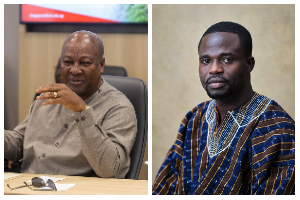
Award-winning investigative journalist, Manasseh Azure Awuni, has opposed the call for reparations to African countries because of the transatlantic slave trade, which is being championed by Ghana’s President, John Dramani Mahama.
In a post shared on social media on March 25, 2026, Manasseh Azure indicated that although he supports the declaration of slavery as the gravest crime against humanity, which was championed by the President, he does not support calls for reparations to African countries because of slavery.
He contended that African countries played a key role in the transatlantic slave trade by selling their own people to slave masters.
He added that if reparations are to be paid at all, then African countries must also be made to pay some because they too benefited from slavery.
“If reparations are to be paid, countries such as Ghana should also be required to pay them for their role in the slave trade. It will not be right to pay reparations to those who took part and benefited from the slave trade, even though the benefits and exploitation of the enslaved people were disproportional.
“The descendants of the slaves in America, the Caribbean and elsewhere legitimately deserve reparations, but the African countries whose people captured and sold slaves are accomplices, not victims,” he said.
He likened the demand for reparations to Ghana’s fight against illegal mining, popularly known as galamsey.
He said that without the collaboration of Ghanaians, the Chinese illegal miners cannot destroy Ghana’s water bodies or forest reserves.
“In 100 years, it will be untenable for Ghana to demand reparations from China for destroying our forests in the illegal mining scourge. Without tacit support in fronting for the Chinese illegal miners (sometimes providing state security protection), they would not have succeeded in destroying our forests.
“We need to tell ourselves the hard truth and learn from how we have hurt ourselves through selfishness and greed,” he said.
Breakdown of Vote on Ghana’s UN Slavery Motion: The countries who voted no and 53 who abstained
Read his full write-up below:
SLAVERY REPARATIONS? BY WHO AND TO WHOM?
Last year, I took an English course in my ongoing programme that got me very close to the subject of the transatlantic slave trade. The course was a study of writings in the Reconstruction Era. We read Frederick Douglas' fiction, Lincoln's speeches, and watched heart-wrenching films such as "Slavery by Another Name."
The harrowing tales I'd heard narrated by tour guides at Ghana's slave castles and captured casually in textbooks I'd read growing up did not come close to the cruelty the slaves endured in the United States and elsewhere.
For this reason, I wholeheartedly agree with the declaration of slavery as the gravest crime against humanity.
President John Dramani Mahama and Samuel Okudzeto Ablakwa deserve immense commendation for pushing and securing the United Nations' passage of the resolution declaring slavery as the gravest crime against humanity.
At the end of the semester, we were to produce a seminar paper. I proposed to my professor that, instead of doing a paper on how the slaves were treated in the United States, I wanted to explore how the slaves got onto the slave ships in the first place.
The literature I read for my paper, including from Africans such as Ghana's Professor Akosua Perbi, showed that Africans were at the forefront of capturing their fellow Africans and selling them to the European slave traders who were based mainly along the coast. The Europeans conducted some raids, but these were at a very minimal level. One source estimated that 90% of the slaves captured and shipped abroad were captured by Africans.
The slave trade boomed whenever there were wars among African ethnic groups. Some wars were waged for the purpose of capturing and selling slaves. The powerful kingdoms got money from selling slaves, with which they bought powerful weapons to fight and capture more slaves.
When the British abolished the slave trade, some powerful African kings, including some in Ghana, were unhappy that their source of wealth was being stifled.
I also read that some African countries, such as Benin, have formally apologised for their role in capturing and selling their own people into slavery.
Ghana subtly acknowledged its role when it launched the Joseph Project during the celebration of Ghana's 50th independence anniversary. (In the Bible, Joseph was sold by his own brothers.)
That brings us to the second part of the push, which is the payment of reparations. If reparations are to be paid, countries such as Ghana should also be required to pay them for their role in the slave trade.
It will not be right to pay reparations to those who took part and benefited from the slave trade, even though the benefits and exploitation of the enslaved people were disproportional.
The descendants of the slaves in America, the Carribean and elsewhere legitimately deserve reparations, but the African countries whose people captured and sold slaves are accomplices, not victims.
In 100 years, it will be untenable for Ghana to demand reparations from China for destroying our forests in the illegal mining scourge. Without tacit support in fronting for the Chinese illegal miners (sometimes providing state security protection), they would not have succeeded in destroying our forests.
We need to tell ourselves the hard truth and learn from how we have hurt ourselves through selfishness and greed.
BAI
Tension in UK Parliament over Ghana's slavery reparations push at UN
General News of Thursday, 26 March 2026
Source: www.ghanaweb.com