The days of banks, hospitals, telecommunications companies and other institutions routinely photocopying Ghana Cards or relying on physical inspection to verify customers' identities are coming to an end, as the National Identification Authority (NIA) begins a nationwide enforcement exercise on Monday, November 2, 2026.
The exercise, led by the NIA's Biometric Verification Taskforce, will target institutions that have failed to comply with the National Identity Register (Amendment) Regulations, 2026 (L.I. 2523), which makes biometric authentication the required method of verifying Ghana Card holders.
Under the new regulations, organisations that use the Ghana Card for identity verification can no longer rely on simply looking at the card, photocopying it, scanning it or retaining an image of it as proof of identification. They are required to use the NIA's Identity Verification System Platform (IVSP) or another approved biometric verification method.
The move represents a significant change in how personal identities are authenticated in Ghana, with institutions expected to abandon a practice that has become commonplace in banking halls, hospital reception areas, insurance offices, telecommunications outlets and other service centres.
But what exactly does the new directive mean for institutions and ordinary Ghanaians? What happens if an organisation refuses to comply, and will customers still be required to present their physical Ghana Cards?
Here are the important things to know.
The explainer: What Ghanaians need to know
1. Why is the NIA stopping Ghana Card photocopying?
The decision is aimed at addressing weaknesses in the traditional method of identity verification, particularly the risks associated with identity theft, document forgery and the unauthorised use of personal information.
For years, several institutions have relied on photocopies, scanned images or visual inspection of Ghana Cards when opening bank accounts, processing insurance applications, registering SIM cards and providing other services.
However, the NIA argues that these methods do not establish whether the person presenting the card is its rightful owner.
A photocopy can be altered, a scanned image can be reproduced, and a card's details can be retained or reused without the owner's knowledge.
Speaking on the new regulations, Interior Minister Muntaka Mohammed-Mubarak explained the problem with the old system:
"For too long, identity checks in this country have relied on officers glancing at the card or businesses photocopying and filing it away."
He added that a photocopy could be altered, while a scanned image could be misused or reused without the cardholder's knowledge or consent.
2. What exactly will change from November 2?
The new regulations require institutions that verify identities for regulated transactions to move from physical inspection to biometric authentication.
Instead of an employee simply looking at a Ghana Card or making a photocopy, the institution must authenticate the person's identity using an approved system.
The NIA has outlined the following requirements:
- No photocopying: Institutions must not request, reproduce or retain photocopies of Ghana Cards for identity verification.
- No scanned images: Scanned copies and digital images of the card cannot be used as substitutes for proper authentication.
- No visual inspection: Employees can no longer rely on looking at the photograph and personal details on the card as proof of identity.
- Biometric verification: The individual's identity must be confirmed through an approved biometric process.
- Approved technology: Institutions must use the NIA's Identity Verification System Platform or an approved match-on-card device.
The biometric process involves matching an individual's fingerprints or other approved biometric information against records in the National Identity Register.
Match-on-card verification is another permitted method, provided the equipment has been approved by the NIA.
3. Which institutions are affected?
The directive is not limited to banks. It applies to organisations legally required to verify people's identities before completing regulated transactions.
These include:
- Commercial banks and other financial institutions.
- Telecommunications companies.
- Insurance companies.
- Pension institutions.
- Hospitals and institutions providing services under the National Health Insurance Scheme.
- Government ministries, departments and agencies.
- Educational institutions.
- Other regulated businesses and service providers.
The underlying legal framework, L.I. 2111, already requires the use of the Ghana Card for several transactions, including opening personal bank accounts, purchasing insurance, registering SIM cards, paying taxes, voter registration and accessing government services.
Educational admissions and other financial transactions were also included in subsequent NIA notices.
4. What happens to institutions that refuse to comply?
The November 2 exercise is intended to move the regulations from the transition and onboarding stage into active enforcement.
The NIA's Biometric Verification Taskforce is expected to pursue institutions that continue to use prohibited verification methods.
Under the regulations, a corporate organisation found guilty of an offence upon summary conviction faces a fine ranging from 500 to 2,000 penalty units.
At GH¢12 per penalty unit, this translates into:
MINIMUM FINE FOR A CORPORATE ORGANISATION
GH¢6,000
500 penalty units
MAXIMUM FINE FOR A CORPORATE ORGANISATION
GH¢24,000
2,000 penalty units
The regulations also prescribe penalties for other categories of offenders. Reports on the enforcement directive have put the fines for individuals at between 50 and 500 penalty units, equivalent to GH¢600 and GH¢6,000.
Importantly, the legal provisions also distinguish partnerships and other undertakings, for which the stated range is 200 to 1,000 penalty units, payable by each partner or responsible person, as applicable.
5. Will Ghanaians still need to carry their physical Ghana Cards?
One important aspect of the new arrangement is that the physical card will no longer be the only means of establishing identity.
According to the NIA, where real-time biometric verification is available, individuals will not be required to present their physical Ghana Cards for the purpose of identity verification.
This means that the emphasis will shift from the appearance of the card to whether the person undergoing verification matches the biometric information held in the national database.
However, the Ghana Card itself remains Ghana's national identity document. The new regulations change the method of authentication, not the status of the card.
6. What must institutions do to avoid prosecution?
The NIA has urged organisations that have not yet integrated their operations with the Identity Verification System Platform to begin the onboarding process immediately.
The authority has outlined a process through which institutions can obtain access to the platform.
According to information published on the NIA's website, the process involves:
1. Completing and submitting an identity verification request form to the NIA.
2. Providing relevant documents, including business registration certificates, regulatory licences and a valid Data Protection Commission certification, where applicable.
3. Submitting information about the organisation's operations, how it intends to use the Ghana Card and the data it requires.
4. Allowing the NIA to review the application and engage the institution on its requirements.
5. Setting up the necessary technical infrastructure and signing an agreement with the NIA before access is granted.
Institutions can begin the process through the authority's website, www.nia.gov.gh, or by emailing idverification@nia.gov.gh.
7. When did the new regulations come into force?
The National Identity Register (Amendment) Regulations, 2026 (L.I. 2523), were signed by the Minister responsible for the National Identification System, Muntaka Mohammed-Mubarak, on March 27, 2026, and gazetted on the same day, according to the NIA.
The regulations officially came into force on June 9, 2026.
The government subsequently provided institutions with time to acquire the necessary biometric equipment, integrate their systems and train personnel before full enforcement.
The November 2 deadline therefore marks the beginning of the NIA's nationwide enforcement exercise, rather than the date on which the law first became effective.
8. Does the directive mean institutions can never request a copy of a Ghana Card?
The distinction is important.
The new regulations prohibit requesting, photocopying, scanning, reproducing or retaining Ghana Cards for identity verification purposes, except where permitted by law.
The requirement is not simply that institutions should stop using photocopiers. They must adopt an approved method of authenticating the identity of the person presenting the card.
The NIA's position is that looking at the card or keeping an image of it does not establish that the person presenting it is the legitimate cardholder.
The authority is therefore seeking to make biometric authentication the standard for identity verification, with the aim of reducing opportunities for fraud and protecting the personal information of Ghanaians.
What this means for ordinary Ghanaians
For customers, the biggest change will be experienced at service centres where presenting a Ghana Card and leaving behind a photocopy have long been part of routine transactions.
Customers should expect institutions to use biometric verification instead of requesting photocopies or relying on employees to inspect the cards.
The new system is also expected to change how organisations manage customers' identity information, reducing their reliance on physical and digital copies of national identity documents.
However, the success of the exercise will depend largely on how quickly institutions integrate the approved technology and how effectively the NIA enforces the regulations.
With the Biometric Verification Taskforce beginning its nationwide exercise on November 2, institutions that continue to rely on the old verification practices risk prosecution and financial penalties.
EA
General News of Monday, 2 November 2026
Source: www.ghanaweb.com
Explainer: Ghana Card photocopying crackdown begins TODAY
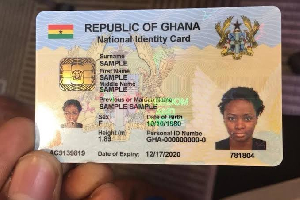 A photo of a Ghana Card