Key findings have emerged from the investigative report of the technical committee set up by the National Road Safety Authority (NRSA) to probe the rising number of crashes involving Toyota Voxy vehicles.
This follows the ban on the commercial use of converted Toyota Voxy vehicles, citing serious safety risks to passengers and drivers on Ghana’s roads.
Transport operators reject NRSA ban on Toyota Voxy vehicles
According to a 3news.com report published on Thursday, April 9, 2026, Godwin Kafui Ayetor, Chairman of the Toyota Voxy Technical Working Group, said the vehicles were never intended for commercial use and that unsafe local conversions have worsened the problem.
Read the key reasons for the decision taken to ban the commercial use of converted Toyota Voxy vehicles below:
On Engineering Integrity
Toyota Tsusho Corporation confirmed that it does not manufacture left-hand drive versions of the Voxy or Noah models, as they are produced exclusively for the Japanese domestic market.
The company further stated that it has never endorsed or approved RHD-to-LHD conversions, declining requests to perform such conversions at its Complete Knock-Down (CKD) plants due to safety concerns.
Despite this, approximately 90% of conversions are carried out locally in Ghana by artisans, many of whom acquired skills through informal apprenticeships.
Field investigations revealed substantial modifications including complete dashboard removal, wiring harness splicing, and structural alterations that compromise vehicle integrity.
The absence of formal standards, qualified supervision, and practitioner certification places passengers at risk, particularly given that critical safety systems (braking, steering, electrical) are directly affected.
Notably, none of the conversion centres visited had registered with the NRSA as required by law.
On Suitability for Commercial Transport
Toyota Tsusho Corporation's official correspondence states unequivocally that only the HiAce, GranAce, and Coaster are designed for commercial passenger transport.
The Voxy is positioned as a minivan for young, middle-class families, with a ground clearance of 150mm compared to 185mm for the HiAce, a critical indicator of unsuitability for long-distance commercial travel on Ghana's roads.
Drivers confirmed that following conversion, vehicles are often fitted with longer struts and larger tyres to compensate for inadequate ground clearance. Registration data reveals approximately 3,570 Voxy vehicles were registered in the first two months of 2026 alone, compared to 3,687 for all of 2025.
While only 34% are registered as commercial vehicles, field evidence confirms widespread use of privately registered Voxy vehicles for commercial passenger transport.
On Regulatory Compliance
The investigation revealed systemic regulatory failures. Section 58 of the Customs Act, 2015 (Act 891) prohibits the import of right-hand drive vehicles without Ministerial approval, yet over 7,257 such vehicles have entered Ghana.
The Ghana Standards Authority has failed to enforce GS 4510:2022, which would prevent RHD imports through pre-shipment conformity assessment. The DVLA registers converted vehicles without the enhanced inspection required under Road Traffic Regulations, 2012 (L.I. 2180).
The NRSA has not enforced Regulations 75 and 76 of L.I. 2468, which mandate registration of service providers and ensure only qualified persons perform road transport-related services.
The MTTD has failed to verify that vehicles registered as private are not used commercially. On Crash Data and Trends: National crash data from 2020-2025 shows a 9.3% increase in crashes in 2025, reversing a three-year downward trend.
Critically, the fatality rate per100 crashes reached 20 in 2025 which is the highest in the period indicating increased crash severity. While Voxy crashes represent less than 1% of national figures, their regional impact is disproportionately high: in Bono Region, Voxy crashes account for 14.6% of all crashes; in North East Region, 12.7%; and in Western Central Region, 11.0%.
Stakeholder interviews consistently attributed crashes to unrealistic sales targets (GH3,500 - 4,000 weekly) that compel inexperienced drivers to speed.
Primary Recommendations
Immediate Enforcement (0-6 Months): Enforce the Customs Act prohibition on RHD imports through joint inspections at all entry points. Launch joint DVLA-MTTD operations to sanction owners of vehicles registered for private use but are being used for commercial purposes.
NRSA and MTTD limit the use of all Toyota Voxy vehicles registered for commercial use to intra-city commutes only. Issue a public advisory warning of the risks identified in this report. Cease registration of non-compliant converted vehicles pending a national standard.
Govt bans use of Toyota Voxy vehicles for commercial transport
Regulatory Strengthening (6-12 Months): Fully implement GS 4510:2022 for pre-shipment conformity assessment. Establish enhanced commercial driver licensing with minimum experience requirements and defensive training. Mandate rigorous technical inspection and testing for existing converted commercial vehicles.
Standard Development (12-24 Months): Develop a comprehensive national standard for vehicle conversions mandating manufacturer-designed components and prohibiting structural modifications. Establish certification and registration for conversion workshops. Implement speed limiter regulations for all commercial passenger vehicles.
Strategic Measures (24+ Months): Modernise crash data collection and management systems. Formalise inter-agency data sharing through Memorandum of Understanding. Engage with vehicle-exporting nations to prevent RHD exports to Ghana.
MAG/VPO
RNAQ Divorce: Court awards ex-wife GH¢300k, dismisses GH¢50m settlement claim
General News of Thursday, 9 April 2026
Source: www.ghanaweb.com
Ban on Voxy Cars for Commercial Use: Read key findings by technical committee
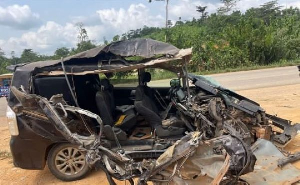 The commitee investigated road crashes involving Toyota Voxy vehicles




Entertainment