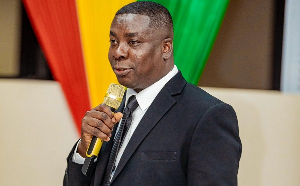
Former Minister of Local Government and Decentralisation, Professor Kwamena Ahwoi, has warned that Ghana’s national unity could be threatened if decentralisation is mismanaged, cautioning that a “troublesome Ashantehene” could potentially create serious problems for the country.
Speaking at a sensitisation and policy orientation workshop organised by the Inter-Ministerial Coordinating Committee on Decentralisation (IMCC) on May 19, 2026, Prof Ahwoi said decentralisation, if poorly handled, could open the door to separatist tendencies and weaken national cohesion.
Prof Ahwoi, who also chairs the IMCC Technical Committee, stressed that decentralisation must be carefully designed to prevent political fragmentation.
“In decentralising, you must be aware that there are separatist tendencies. It is very easy to move from decentralisation to separation, to federalism, to balkanisation, to secession and to the breakdown of the country,” he warned.
He explained that Ghana’s governance system intentionally maintains a relatively weak regional structure to protect national unity.
According to him, Ghana, like many African countries, was shaped by colonial boundaries rather than organic nationhood, describing it as an “artificial colonial construct.”
Prof Ahwoi argued that powerful traditional states such as the Ashanti Kingdom had historically possessed the capacity to expand beyond their current boundaries if not for colonial intervention.
“Fortunately, we have had wise Asantehenes who have not created a problem but if we get an Asantehene who is troublesome, he will create problems for the nation of Ghana,” he cautioned.
Ashantis can easily take over Ghana to form their own country - Prof Ahwoi
He further cited the collapse of the former Soviet Union and Yugoslavia, as well as Nigeria’s civil war following the attempted secession of Biafra, as examples of how internal divisions can escalate into national fragmentation.
Prof Ahwoi stressed that while decentralisation is essential for governance and development, it must be implemented in a way that strengthens rather than weakens national unity.
The workshop, attended by media practitioners and policy stakeholders, formed part of efforts to build public awareness and support for Ghana’s new National Decentralisation Policy and Strategic Framework (2026–2030).
AM
General News of Friday, 22 May 2026
Source: www.ghanaweb.com
'If we get a troublesome Ashantehene he will create problems for Ghana' - Prof Ahwoi
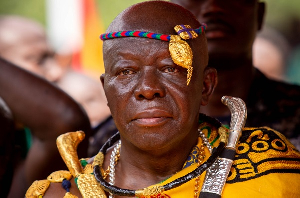 Otumfuo Osei Tutu II is the Asantehene