The United Nations General Assembly, on Wednesday, March 25, 2026, adopted a resolution championed by Ghana, which declared the “trafficking of enslaved Africans and racialised chattel enslavement of Africans as the gravest crime against humanity.”
Proceedings of the 80th session of the UN General Assembly showed that Ghana went ahead with the resolution against the wishes of the United States (US), the United Kingdom (UK) and the European Union (EU).
These world superpowers had several issues with the motion, including the description of the slavery of Africans as “the gravest crime against humanity,” and the demand for reparations to African countries before they would support the resolution, but Ghana, led by its President, John Dramani Mahama, did not budge.
It presented the resolution, which was numbered A/80/L.48, to the UN plenary and managed to get 122 out of 193 UN countries to support it.
As pointed out, the resolution also advances the global conversation on reparatory justice for the enslavement of Africans.
Some key points of the resolution include:
1. The recognition that for 400 years, the trafficking of enslaved Africans and racialised chattel enslavement of Africans forcibly captured, commodified and transported millions of African men, women and children, constituting the largest forced migration in history and one of the longest-running systems of organised mass human exploitation in recorded history, with millions more dying during capture, detention and trafficking across oceans.
2. The acknowledgement that diverse legal and moral traditions across the world have affirmed the inherent dignity of all human beings, and recognising in particular African jurisprudence, such as the Kouroukan Fouga (Manden Charter) of 1235, which established through Article 5 that everybody has a right to life and to the preservation of physical integrity and established the sovereignty of life over property.
3. The affirmation of the importance of addressing historical wrongs affecting Africans and people of African descent in a manner that promotes justice, human rights, dignity and healing, and emphasising that claims for reparations represent a concrete step towards remedying historical wrongs against Africans and people of African descent.
Why US voted against Ghana's resolution to declare slavery a crime against humanity
Read the full document below:
BAI
Why US voted against Ghana’s resolution to declare slavery a crime against humanity
General News of Friday, 27 March 2026
Source: www.ghanaweb.com
FULL TEXT: Read Ghana’s UN resolution on slavery that defied the West
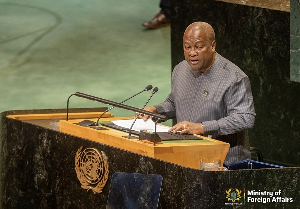 President John Dramani Mahama championed Ghana's UN resolution on slavery