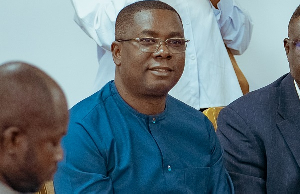
Kurt Okraku's future in football administration could soon become one of the biggest questions facing Ghana football.
The Ghana Football Association president now has the option of seeking a third term after Congress amended the statutes to allow a president to serve three four-year terms.
But at a time when Okraku's domestic administration is facing growing criticism, there is another possibility that could make his next move even more intriguing.
Could the CAF presidency become a bigger ambition than remaining at the GFA?
Okraku has been at the helm of Ghana football since 2019, winning re-election in 2023.
The latest amendment means he can potentially remain in office until 2031.
However, his tenure is entering a difficult period.
The Black Stars failed to qualify for the 2025 Africa Cup of Nations for the first time in 20 years, while Ghana's recent national-team performances have continued to generate frustration.
The concerns extend beyond the Black Stars.
Critics have questioned the development of Ghana's youth national teams and the general growth of the domestic game under Okraku.
Calls for his resignation intensified after the World Cup, while questions about the value of another term have increasingly entered public discussion.
And now there is a potential challenger.
Former Black Stars captain André Ayew is increasingly being mentioned as a possible candidate for the GFA presidency.
Ayew has not formally declared a bid, but the conversation has moved beyond ordinary speculation.
Former GFA vice-president George Afriyie has publicly urged him to consider contesting and argued that Ghana football needs competition for its top position.
That potentially changes the equation for Okraku.
A third term would not necessarily be the straightforward continuation of his presidency that it might have appeared to be when the constitutional amendment was approved.
He could face a campaign against one of Ghana's most recognisable football figures, a former Black Stars captain with a huge profile among supporters.
And while Okraku would have the advantage of experience, incumbency and an established network within Ghana football, Ayew could make the election a referendum on the direction of the association.
That brings the CAF question into sharper focus.
Okraku has risen considerably within African football politics. He currently serves as CAF second vice-president and is a member of the CAF Executive Committee for the 2025-2029 term.
There have also been reports and suggestions that he could harbour ambitions of eventually becoming CAF president.
If that ambition is real, Okraku could eventually face a fascinating calculation.
Does he fight to retain the GFA presidency while Ghana football remains deeply divided over his record, or does he concentrate his energy on building an African coalition for CAF's top job?
The second option, however, carries enormous risk.
If he leaves the GFA presidency to pursue CAF and fails to win, he could lose both positions.
And that is why the decision could be the biggest gamble of Okraku's political career.
Remaining at the GFA gives him another four years to improve his record and strengthen his domestic base.
But it also means another election, potentially against Dede Ayew, with every failure of the national teams and every unresolved problem in Ghana football likely to become ammunition for the opposition.
Moving towards CAF could offer a different path, one where his growing influence on the continent becomes the centrepiece of his legacy.
For now, there is no confirmed declaration that Okraku will contest the CAF presidency, just as Ayew has not formally announced a GFA presidential bid.
But the possibilities are becoming increasingly difficult to ignore.
FKA/AM
Sports News of Saturday, 29 August 2026
Source: www.ghanaweb.com
CAF Presidency or GFA Third Term? The big gamble facing Kurt Okraku
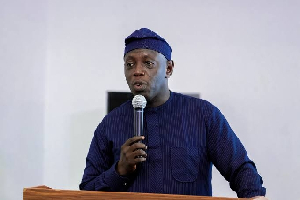
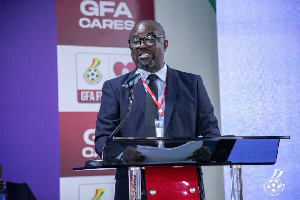 Ghana Football Association president, Kurt Okraku


Entertainment