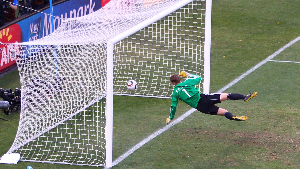
It was supposed to be a turning point in a World Cup knockout match but instead it became a turning point in football history.
In Bloemfontein, during the 2010 FIFA World Cup Round of 16 clash between England and Germany, Frank Lampard received the ball just outside the box and unleashed a dipping shot.
It crashed off the crossbar, bounced clearly over the line, and spun back into play. Lampard turned away, arms half-raised, already celebrating what should have been the equaliser.
But the whistle never came. The referee waved play on. The assistant referee stayed still. The goal did not exist in the eyes of the officials.
Somali businessman offers Omar Artan $100,000 after World Cup heartbreak
England, trailing 2–1 at the time, watched in disbelief as a moment that could have changed everything was erased in seconds.
Instead of 2–2, the game carried on with Germany still ahead, and the momentum shifted brutally.
Germany went on to exploit the confusion and space left behind, eventually winning 4–1 in one of England’s heaviest World Cup defeats.
The incident instantly exploded beyond the stadium. Replays showed what everyone suspected in real time: the ball had crossed the line by a clear margin.
There was no controversy in the footage, only in the decision.
That moment became known worldwide as the “ghost goal.” It was not just about England’s heartbreak; it exposed a deeper problem in football.
For years, the sport had resisted technological intervention in decision-making, relying entirely on human judgment in fast, high-pressure situations.
The debate that followed was louder than ever before. Officials, coaches, and fans demanded change, but this time it didn’t fade away like previous controversies. FIFA could no longer ignore it.
While goal-line technology had been discussed long before 2010, it had always been resisted on the grounds of cost, disruption to the flow of the game, and fear that football would lose its human element.
But Bloemfontein changed the tone of the conversation. It was no longer theoretical. It was no longer about “what if.” It was about a clear, visible mistake on the biggest stage of all.
The turning point was not immediate approval, but a shift in mindset. Trials began in earnest, with different systems tested in domestic leagues and tournaments across Europe. Gradually, resistance softened.
By 2012, the International Football Association Board finally approved goal-line technology for use in official competitions.
And so, by the 2014 FIFA World Cup in Brazil, football entered a new era. For the first time, referees were supported by technology that could confirm whether the ball had crossed the line with absolute certainty.
The uncertainty that once defined moments like Lampard’s was removed.
Watch the video below:
@goals_world_cup Frank Lampard 😳 goal disallowed 💔 WC2010 #Lampard #England #Germany #worldcup #southafrica2010 #fyp #viral #edit #football #footballtiktok ♬ son original - football
FKA/JE
Meanwhile, watch as Jeffrey Nortey shares his career journey from comedy to content creation