The National Council for Curriculum and Assessment (NaCCA) has urged international curriculum providers and schools operating in Ghana to incorporate Ghanaian cultural values and local contexts into their teaching programmes.
The Council says that while international curricula offer learners valuable global exposure, it is equally important for students to understand Ghanaian culture, values and heritage.
Speaking to the media at the Pearson Learner Awards 2026, Deputy Director-General of NaCCA in charge of Technical Services, Dr Eric Amoah, commended schools and learners for their outstanding academic achievements, particularly Crystal Heights International School, which received 26 awards.
He also praised teachers for their dedication and commitment to academic excellence, urging learners to work harder to achieve even greater success in future editions of the awards.
On the integration of Artificial Intelligence (AI) into education, Dr. Amoah said the technology was here to stay and must be embraced by Ghana's education system.
He disclosed that the ongoing curriculum review, covering Kindergarten to Primary Six, places significant emphasis on Artificial Intelligence, coding, computational thinking and robotics.
However, he cautioned that learners must be guided on the responsible use of AI, particularly in developing appropriate prompts and ensuring that the technology supports rather than undermines their learning.
Dr. Amoah further stressed the need to equip teachers with the necessary skills to integrate AI into lesson planning and classroom instruction as Ghana moves towards a technology-driven education system.
Out of the 34 awards presented at the ceremony, Accra-based Crystal Heights International School secured 26, while the remaining eight were shared among other participating schools in Ghana.
The school's impressive haul comprised 12 Highest Mark in the World awards and 14 Highest Mark in Africa awards, underscoring its strong performance in the 2025/2026 Pearson Edexcel examinations.
The award recipients were among more than 2,700 learners from 740 schools across 85 countries who qualified for recognition following the examinations.
Speaking on the school's achievement, Daniel Lomotey Nartey, Principal in charge of the Pearson Division at Crystal Heights International School, expressed excitement over the performance, attributing the success to the collective efforts of school management, teachers, parents and learners.
He commended the school's management for investing in infrastructure, providing essential teaching and learning resources, and ensuring that teachers receive the necessary support to deliver quality education.
Nartey also acknowledged the significant contribution of parents, particularly their commitment to providing learning materials, participating in parent-teacher engagements and implementing teachers' recommendations to enhance their children's academic development.
On the school's approach to Science, Technology, Engineering and Mathematics (STEM) education, Nartey disclosed that Crystal Heights International School has a dedicated robotics laboratory supported by trained teachers who provide learners with practical learning experiences.
He explained that the initiative enables students to apply classroom knowledge to real-life situations rather than relying solely on memorisation.
For instance, mathematical concepts such as measurement, area and volume are applied when designing and creating objects in the robotics laboratory.
According to him, this hands-on approach helps learners develop critical thinking, creativity, problem-solving and innovation skills.
Nartey said the achievement of the 26 learners reflects the school's commitment to academic excellence and practical, skills-based education.
Lisa Evans, Global Marketing Director and Sales Director for Africa, Europe and the Americas at Pearson, said AI presents both exciting opportunities and challenges for learners worldwide.
She stressed that although AI is transforming education, its application must be guided by teachers to ensure that technology supports rather than replaces the role of educators.
According to her, Pearson is working closely with global education experts and institutions, including UNESCO and the Department for Education, to ensure that AI-powered learning resources and assessment systems prioritise teacher leadership and learner safety.
Regional News of Saturday, 21 November 2026
Source: George Nyarvor, Conytributor
NaCCA urges international schools to incorporate Ghanaian values into their curricula
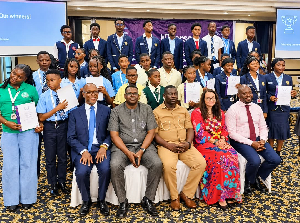 Some of the stakeholders at the event