Rhoda Asare, a Senior Programmes Officer with the Ghana National Commission on Small Arms and Light Weapons (NACSA), has completed the 2026 United Nations Programme of Fellowship on Disarmament. She received her certificate at the UN Headquarters in New York on 26th October, 2026.
The Fellowship, which has been coordinated by the UN Office for Disarmament Affairs (UNODA) since 1978, trains government officials from around the world in disarmament, arms control and non-proliferation. Asare represented Ghana in the 2026 cohort.
The programme began with online courses facilitated by the UNODA, United Nations Institute for Training and Research (UNITAR), United Nations Office on Drugs and Crime (UNODC) and the Organisation for the Prohibition of Chemical Weapons (OPCW), between April and May. This was followed by three study segments in June, where the Fellows visited Geneva, The Hague and Vienna. They also engaged with the Conference on Disarmament, the Arms Trade Treaty Secretariat, the Organisation for the Prohibition of Chemical Weapons (OPCW), the International Atomic Energy Agency, the Comprehensive Nuclear-Test-Ban Treaty Organisation, the International Court of Justice and the International Criminal Court.
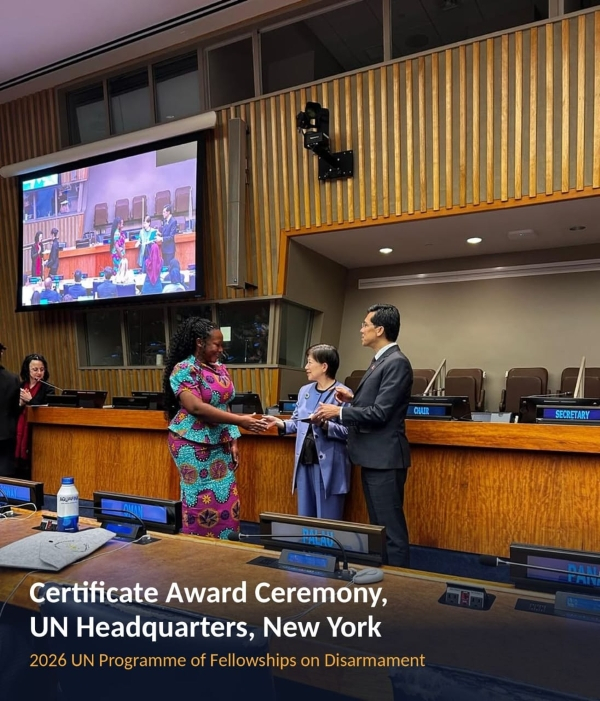
From August to September, the Fellows had the opportunity to travel to Japan, China and the Republic of Korea. In Hiroshima and Nagasaki, they heard first-hand testimony from atomic bomb survivors, whereas in Beijing, they visited the national data centre that supports global nuclear-test monitoring. In South Korea, the team toured the Demilitarised Zone between the two Korean States. The final segment of the Fellowship Programme took place in October during the UN General Assembly First Committee Meeting on disarmament and international security in New York.
Asare and other Fellows from Lesotho and Nepal presented a joint project titled “3D Printing and Autonomous Weapons Systems: Implications for International Security” at the UN Headquarters. The project established that parts of firearms and drones can now be produced from digital files shared online. Such weapons carry no serial numbers and escape the marking, licensing and tracing systems which effective arms control demands.
“The small arms threat to Ghana is changing faster than our laws and systems,” Asare noted. She further explained that Ghana’s existing challenge of locally manufactured guns could take a digital form that is even harder to detect.
Drawing on the Fellowship, Asare has proposed several measures and recommendations to the Commission, some of which include a review of the Arms and Ammunition Act, 1962 (Act 118) to cover 3D-printed firearms, digital blueprints and armed drones; an Emerging Arms Technologies Desk to monitor new threats; a national tracing and record-keeping system for seized weapons; stronger border and inter-agency cooperation; and a national position for Ghana in international talks on autonomous weapons.
She also expressed gratitude to the Executive Secretary and Management of NACSA for nominating and supporting her, and to UNODA and the host governments for the rich learning experience.
As the digital age redefines the boundaries of global security, Asare’s return to Ghana marks not just a personal milestone, but a critical turning point for the nation's fight against illicit proliferation of small arms.
Armed with global insights from Geneva to Hiroshima, she stands ready to transform her groundbreaking fellowship experience into localised action. By bridging the gap between traditional arms control and the invisible, borderless threat of 3D-printed weapons and autonomous drones, her visionary roadmap ensures that Ghana stays one step ahead of tomorrow's conflicts—proving that national resilience begins with foresight, innovation and unwavering vigilance.
Regional News of Monday, 16 November 2026
Source: NACSA
2026 UN Disarmament Fellow: Ghanaian officer demands action on 3D-guns, drones
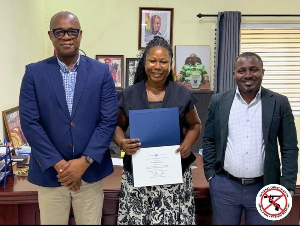 Dr Adam Bonaa (L) , Ms Rhoda Asare (M),and Mr Mohammed Gali Salam (R)


Entertainment