The spokesperson for the Municipal Chief Executive (MCE) of Awutu Senya East Municipal Assembly in the Central Region, Mr Abdul-Rahman Mohamed, has vehemently denied allegations that the MCE is renting newly built stores in the Kasoa Old Market area to traders at exorbitant prices.
According to him, the allegations levelled against the MCE are baseless, fabricated and unfounded because the MCE is not directly responsible for allocating the newly built stores to beneficiary traders.
Speaking in an interview with this news outlet, Africa, Mr Mohammed reaffirmed that neither the MCE nor the Assembly is directly involved in negotiations for new store allocations to the traders in the Kasoa Old Market area.
Furthermore, he asserted that the ongoing allegations against the MCE are being fueled by some leaders of the New Patriotic Party (NPP) for the Awutu Senya East Constituency and a self-styled chief within the municipality.
He added that whatever amount the developers charge the traders through rental agreements will remain valid for a ten-year period before becoming subject to renewal.
He again reiterated that the MCE has no direct involvement in determining how much the developers charge per store. "The MCE did not engage anyone on that matter," he was setting the record straight.
Mr. Mohammed explained that his intelligence on the ground suggests these individuals incited the traders to make these claims to create unrest around the Kasoa Old Market area, aiming to make both the current government and the MCE unpopular in the municipality—an attempt he vowed would completely fail.
He reaffirmed that decisions on the allocation and payment for the new ultra-modern stores, built by investors and developers in the Kasoa Old Market area, have been handled transparently.
He clarified that the MCE does not decide on the payment terms for stores developers rent to traders.
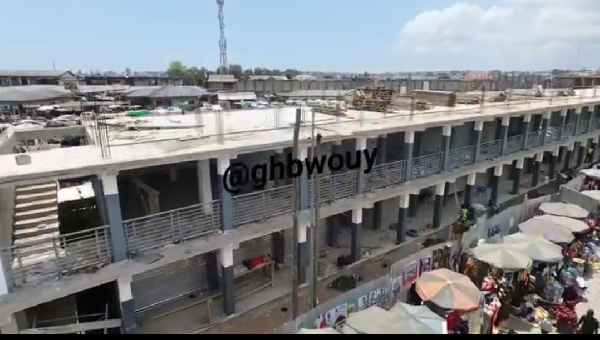
According to the spokesperson, the uproar began after the New Patriotic Party (NPP), led by Mrs Hawa Koomson, visited the traders, which subsequently led to the organisation of a press conference and a demonstration around the Kasoa Old Market area.
He noted that the public-private partnership (PPP) agreement the Assembly signed with the developers specifies that, upon completion of the stores, the developers will deal directly with the traders who previously occupied the area before relocating to the Iron City Market—provided the traders can rent the newly built stores.
The spokesperson said the alternative for the previous occupants was the Iron City Market area, just a three-minute drive from the Kasoa Old Market premises.
To provide further relief for the traders, the Assembly directed that no market tolls be collected for the first few months, until the traders were well settled at Iron City.
He also added that approximately 150 traders were resettled at the Iron City Market centre, where each trader has a shed, a mounted container, or a makeshift structure from which they sell their wares.
He explained that some of these traders became agitated and decided to return to Kasoa town to sell on the streets, believing that this is where customers mostly pass by to patronise their goods—a practice the Assembly forbids under its bylaws and regulations.
He pointed out that all meetings on implementing the PPP agreement for the Kasoa Old Market redevelopment project involve management, which comprises both the developers and the Assembly technocrats.
He noted again that under the build-operate-transfer (BOT) arrangement, the developers will oversee the market redevelopment project for 30 years.
"And then the Awutu Senya East Municipal Assembly's equity in the project—after the developers are done engaging the beneficiary traders to occupy the built stores—will allow the Assembly to collect its equity in the form of revenues," he explained.
He informed journalists that the Assembly will not begin collecting daily market tolls from the area after the traders occupy the stores.
He pointed out that 30 percent represents the Assembly's equity, derived from an agreed-upon share it will receive from the developers.
"So we, as the Assembly, are not going to deal directly with the occupants or traders in the new stores under the new market redevelopment project at the Kasoa Old Market area," he further explained, adding that traders deal directly with the developers on store payment arrangements.
He again added that many traders had acquired stores built by investors/developers through a PPP agreement with the Assembly.
However, they received information that some of these beneficiary traders were subletting their stores to others due to the highly economically viable location of the Kasoa Old Market area.
When asked if he had monitored the situation to ensure the developers/investors were not charging exorbitant prices, the spokesman for the MCE responded that the management team—comprising the developers, the Assembly's technocrats, and the MCE himself—had reviewed the valuation of the built stores.
He explained that because other market development projects are within the enclave, the prices were set at standard market rates and were comparable to similar projects around the Kasoa Old Market area.
"The allocation prices for the stores reflect fair market value, and I understand that this is for ten years based on the contractual agreements between the developers and the beneficiary traders.
"Therefore, if the traders rent the stores, they can only review their rent agreement with the developers after ten years," he explained.
The spokesperson for the MCE noted that Kasoa is currently a peaceful community.
He called on traders and residents to desist from following individuals whose sole intention is to cause disaffection and create the false impression that there is a lack of peace and development under his leadership and the current government.
.
Regional News of Tuesday, 10 November 2026
Source: Freeman Koryekpor Awlesu, Contributor
Awutu Senya East MCE Office denies renting Kasoa New Market stores at exorbitant prices
 Seth Sabah Serwornoo-Banini is the MCE for Awutu Senya East