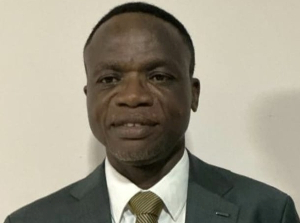
Emmanuel Armah-Kofi Buah, Minister of Lands and Natural Resources, says the protection of Ghana’s natural resources is a shared responsibility that requires the commitment of government, traditional authorities, mining communities and all stakeholders.
He made the call when he launched four more Responsible Cooperative Mining Schemes — two in Tarkwa and two in Bogoso — under the Responsible Cooperative Mining and Skills Development Programme (rCOMSDEP) in the Western Region on Monday, 9th November 2026.
The schemes are expected to create local jobs and encourage miners to shift to responsible mining practices instead of illegal mining, which has destroyed forests, water bodies and agricultural productivity in the country.
In his address, Armah-Kofi Buah called for regulatory compliance, environmental protection and renewed commitment to the national fight against illegal mining as he launched the programme in Tarkwa and Bogoso, in the Tarkwa Nsuaem Municipality and Prestea Huni-Valley District respectively.
The Minister stressed that the sustainable development of Ghana’s mining sector depended heavily on strict adherence to mining regulations, responsible extraction practices and a collective determination to protect the country’s natural resources.
To this end, he noted that the fight against illegal mining must remain a national priority, requiring the commitment of government institutions, traditional authorities, mining communities and all other key stakeholders.
He emphasised that the launch of rCOMSDEP in Tarkwa and Bogoso — two giant ancient mining communities in the Western Region — represented an important step towards strengthening community participation in responsible mining and ensuring that mining activities deliver meaningful benefits to host communities.
According to him, the initiative must serve as a platform for promoting responsible mining practices while reinforcing government’s commitment to sustainable natural resource management.
Armah-Kofi Buah cautioned that the pursuit of economic benefits from mineral resources should not come at the expense of environmental sustainability, and stated that the destruction of forest reserves nationwide amounted to over twelve thousand (12,000) football fields.
Consequently, the Minister maintained that Ghana’s rivers, forests, farmlands and other ecological assets must be protected against destructive mining activities, particularly those associated with illegal small-scale mining.
The Minister further underscored the importance of regulatory compliance, urging mining operators to work within the established legal and institutional framework governing the sector.
He explained that compliance with mining laws and environmental standards was essential to protecting communities, promoting investor confidence and ensuring that the country’s mineral wealth contributes meaningfully to national development.
On the fight against illegal mining, the Minister called for greater vigilance and collaboration among all relevant stakeholders.
He maintained that government remained determined to confront illegal mining activities and would continue to strengthen measures aimed at protecting water bodies, forest reserves and other environmentally sensitive areas.
He also encouraged mining communities to take ownership of the programme and actively participate in efforts to promote responsible mining.
He observed that sustainable mining could only be achieved when local communities understood their responsibilities, supported lawful mining operations and rejected activities that threatened their livelihoods and the environment.
The commissioning of four rCOMSDEP schemes in the two most talked-about mining communities is therefore expected to reinforce efforts to improve coordination, community engagement and institutional support for responsible community mining.
The initiative, the Minister said, also presented an opportunity to deepen awareness of the need to balance mineral resource exploitation with environmental protection and the long-term welfare of mining communities.
He reiterated that Ghana’s mineral resources, under the administration of President John Dramani Mahama, would be managed in a manner that creates sustainable economic opportunities without compromising the country’s environmental future.
In line with this, he called on stakeholders to translate their commitments into practical action, stressing that the success of the programme would depend on discipline, accountability and effective implementation.
He concluded with a renewed appeal for collective commitment to regulatory compliance, responsible mining and the national campaign against illegal mining, insisting that the protection of Ghana’s natural resources was a shared responsibility.
He urged all stakeholders to make rCOMSDEP a success and contribute to building a mining industry that supports economic transformation while safeguarding the environment for future generations.
Sheihu Siddiq, Acting National Coordinator of rCOMSDEP, assured the Minister of the commitment to register many cooperatives to formally join the country’s mining industry to open up opportunities and create jobs for Ghanaian youth.
On his part, the Regional Director, Department of Cooperatives, Akwasi Adjei Bawuah, officially welcomed the new cooperatives, and assured them of government’s determination to strengthen and streamline their activities to address widespread illegal mining activities across the region.
Members of Parliament for Tarkwa Nsuaem and Prestea Huni-Valley Constituencies who graced the commissioning expressed optimism that the introduction of the flagship programme would help government to improve the lives of mining communities, expand opportunities and ultimately create jobs for the teeming unemployed youth of their constituencies respectively.
Regional News of Monday, 9 November 2026
Source: Daniel Kaku, Contributor
Protection of Ghana’s natural resources is a shared responsibility - Lands Minister
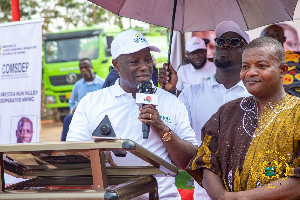 Lands and Natural Resources launches four responsible mining in two Constituencies