The Kwame Nkrumah University of Science and Technology (KNUST) is exploring plans to establish a satellite campus in Ellembelle in the Nzema area of the Western Region in honour of Ghana’s first President, Dr Kwame Nkrumah.
The initiative forms part of a major collaboration being developed between the university and the Ministry of Lands and Natural Resources.
The proposed satellite campus emerged from discussions between the Vice-Chancellor of KNUST, Professor Christian Agyare, and the Minister for Lands and Natural Resources, Emmanuel Armah-Kofi Buah.
Armah-Kofi Buah, who is also the Member of Parliament (MP) for Ellembelle, paid one of his regular visits to the university on Tuesday, November 3, 2026. During the visit, he supported the university’s Engineering Department with a donation of a Fintec laboratory as part of his commitment to the institution.
The engagement is expected to deepen collaboration in education and strengthen the university’s presence in the oil and gas enclave within the Nzema area.
The initiative seeks to honour the legacy of Dr Kwame Nkrumah, whose contributions to Ghana’s independence, industrialisation and educational development remain significant in the country’s history.
Establishing a university campus in his home area, which is endowed with natural resources, would represent an important tribute to his vision of education as a catalyst for national transformation.
The discussions also explored several strategic areas of collaboration aimed at bringing academic research, scientific innovation and technological advancement closer to Ghana’s natural resource management agenda.
Among the key areas identified was Artificial Intelligence (AI), which is increasingly becoming an important tool in modern governance, industrial development and natural resource management.
The proposed collaboration would explore opportunities to leverage technological innovation to improve efficiency, monitoring and decision-making in the natural resources sector.
Mining Engineering also featured prominently in the discussions, with both sides recognising the importance of strengthening technical expertise, research and professional training to support Ghana’s mining industry.
The collaboration is expected to create opportunities for academic and industry engagement to address emerging challenges in the sector.
Another area of cooperation is the application of financial technology (FinTech) in monitoring and evaluating the management of the country’s natural resources.
The discussions recognised the potential of technology-driven systems to improve transparency, accountability and efficiency in resource governance.
The proposed partnership would also focus on monitoring and evaluating Ghana’s forests, water bodies and mineral extraction activities.
“This is particularly important at a time when the country continues to intensify efforts to protect its environment against illegal mining, deforestation and the destruction of critical water resources,” Armah-Kofi Buah said.
The involvement of KNUST, one of Ghana’s leading science and technology institutions, is expected to strengthen the scientific and technical foundations of the Ministry’s policies and interventions through research, innovation and specialised expertise.
The collaboration also presents an opportunity to bridge the gap between academic knowledge and practical governance by ensuring that research findings and technological innovations are translated into solutions to the country’s natural resource management challenges.
The Vice-Chancellor, Professor Christian Agyare, noted that the proposed satellite campus could become an important centre for academic development, skills acquisition and research for the Nzema area and neighbouring communities, while creating opportunities for young people in the Western Region to access higher education closer to home.
The engagement between the KNUST alumnus and the university’s Vice-Chancellor reflects a growing recognition of the need for stronger partnerships between government institutions and academic organisations to address Ghana’s development priorities, particularly in mining, environmental protection, technology and sustainable resource management.
The proposed Ellembelle satellite campus, alongside the other areas of collaboration, therefore represents an opportunity to connect Dr Kwame Nkrumah’s enduring educational legacy with modern scientific innovation and Ghana’s quest for sustainable development.
Regional News of Tuesday, 3 November 2026
Source: Daniel Kaku, Contributor
KNUST explores plans to establish satellite campus in Ellembelle
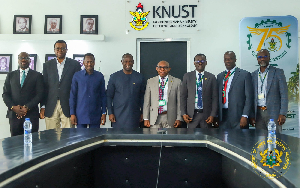 Lands Minister together with management of KNUST