Ghana needs stronger implementation of existing policies and evidence-based interventions to address the social, cultural and economic factors driving teenage pregnancy and HIV among young people, Executive Director of LoveAid Foundation, Princess Lovia Tetteh, has said.
She said the reported 53,414 adolescent pregnancies recorded among girls aged 10 to 19 between January and July 2026 should serve as a warning to policymakers and stakeholders to strengthen interventions targeting adolescents.
Princess Tetteh, however, cautioned that the figure, based on Ghana Health Service facility records, should not automatically be interpreted as representing all adolescent pregnancies nationwide, suggesting that the actual situation could be broader.
Speaking during a peer-led reproductive health education session organised by LoveAid Foundation, she said teenage pregnancy and HIV should not be treated as isolated health problems because they are closely connected to education, poverty, family relationships, gender norms, access to healthcare and economic opportunities.
She said while interventions such as abstinence education, family planning advocacy and sensitisation have important roles to play, information alone is insufficient to enable young people to make healthy decisions.
“A girl may know that pregnancy can interrupt her education and still become pregnant,” she noted, adding that a young person might know about HIV but still be unable to negotiate safer sex or access health services because of fear of judgement.
Tetteh said research by the United Nations Population Fund (UNFPA)identified poverty, low educational attainment, dysfunctional family environments, inadequate reproductive health education, child marriage, coerced sex and contraceptive misconceptions or non-use among factors associated with adolescent pregnancy in Ghana.
She therefore called for interventions to be broadened to include vocational and employable skills, entrepreneurship training, apprenticeships, digital and financial literacy, school retention, menstrual health support, mentorship, career guidance, psychosocial support, livelihood opportunities and support for adolescent mothers to return to school.
She also advocated stronger linkages between social protection, health, education and child protection systems to address the circumstances that make young people vulnerable.
According to her, Ghana already has adolescent-friendly health service frameworks and national plans aimed at improving adolescents’ access to sexual and reproductive health information and services.
“The challenge is therefore not simply creating policies. It is financing, implementing, monitoring and scaling what already exists and closing the gaps,” she said.
Tetteh also stressed the need for continuous, age-appropriate and youth-centred reproductive health education covering puberty, menstruation, fertility, pregnancy prevention, HIV and sexually transmitted infections, consent, healthy relationships, gender-based violence, bodily autonomy and where to seek help.
She said boys and young men must be included in such interventions rather than placing the responsibility for preventing teenage pregnancy largely on girls.
The peer-led session sought to equip young people with practical knowledge on reproductive health, HIV, substance abuse and gender-based violence.
Facilitators included Dion Kukua Fynn, who addressed puberty, identity and youth leadership; Priscilla Dzangmah, who spoke on sexual and reproductive health rights, menstrual health and pregnancy; Jude Ahiagble, who focused on sexual health, STIs and substance abuse; and Arnold Adekplorvi and Zomayi Deladem David, who addressed gender, gender-based violence, reporting and support mechanisms.
Programmes Director of LoveAid Foundation, Joshua Tetteh Ayayi, said the organisation was concerned about the rising HIV and teenage pregnancy cases among young people and was using peer education to reach more adolescents.
He said the organisation had observed possible links between economic activities involving young people and increased vulnerability in some communities, including areas where young people engage in illegal mining and the growing number of young people involved in tricycle riding.
He called for further investigation into such trends to establish their root causes.
Ayayi said LoveAid Foundation had begun discussions with stakeholders, including the Ghana Health Service and gender-related authorities, on extending peer education through school clubs in the Ho Municipality and potentially other districts.
He urged young people to support their peers to make responsible choices, particularly during social activities and festivals, and called for more sustainable partnerships to strengthen the initiative.
Regional News of Friday, 23 October 2026
Source: Desmond Tinana, Contributor
Ghana needs strong implementation to address teenage pregnancies – Tetteh
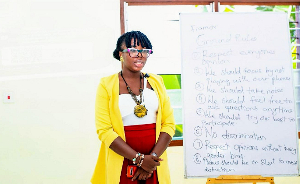 Princess Lovia Tetteh is the Executive Director of LoveAid Foundation