The President of the National Union of Ghana Students (NUGS), Rashid Ibrahim, has called for greater opportunities for young people to take up leadership positions and contribute meaningfully to Ghana's development.
According to him, young leaders have demonstrated their ability to deliver results and should be given the necessary support and opportunities to participate in national decision-making processes.
“The youthful leaders are doing well. Why don’t we give them the opportunity?” he asked.
“I believe that if the youth are given the chance and the right opportunities, they can work to contribute enough to national development,” he added.
Ibrahim explained that his decision to pursue leadership was motivated by the need to create a platform where the concerns of young people could be heard and addressed.
He maintained that young people possessed the potential to make significant contributions to society if given the right opportunities and support.
Ibrahim made the remarks in a documentary titled “We Shall Lead: Voices Shaping the Future of Africa,” which highlights the experiences of young leaders and the challenges confronting youth and women in politics and public life.
The documentary forms part of the European Union Women and Youth Democratic Engagement (WYDE) Political Parties Project, an initiative aimed at strengthening the participation of women and young people in democratic processes.
Also featured in the documentary is the Chief Executive Officer of the Ghana Chamber of Young Entrepreneurs and President of the Ghana Youth Federation, Sherif Ghali, who expressed concern about the limited involvement of young people in political decision-making.
According to him, although efforts were being made to include young people in leadership structures, many continued to be excluded from decisions that directly affected their lives and the country's development.
“The struggle is so serious that young people do not want to go into politics. It is not about including us but allowing us to take decisions,” he stated.
Ghali explained that the exclusion of young people from meaningful decision-making processes had discouraged many from pursuing political leadership.
He stressed that young people would become more interested in politics if they witnessed their peers being given opportunities to contribute to decisions and influence policies.
The Vice President of the Student Representative Council (SRC) of the Ghana School of Law, Hariratah Ibrahim Doudu, also highlighted the challenges women continued to face in their pursuit of political and leadership positions.
“The system of politics is not really created to accommodate women. It is now, in these days, that the system is trying to accommodate women,” she said.
Doudu observed that the political environment had historically presented barriers that discouraged women from participating actively in politics and public life.
What Atta Mills told me before his death - Ps Abdulah shares untold stories about Mills
Sharing her personal experience, she disclosed that growing up in a modest family of 24 siblings and losing her father after Senior High School had strengthened her resilience and determination to pursue leadership.
She recounted that when she decided to contest the vice presidency of the Ghana School of Law SRC, she was surprised to discover that no woman had attempted to contest the position for more than five years, despite women outnumbering men at the institution.
According to her, the situation demonstrated the challenges women faced in pursuing leadership positions, even in institutions where they constituted the majority.
Although she acknowledged that more women were making efforts to challenge existing barriers and create a balance in leadership, she stressed the need for greater support to encourage female participation.
The documentary, “We Shall Lead: Voices Shaping the Future of Africa,” features the experiences and perspectives of political and public leaders from Ghana, Kenya and Uganda.
It explores the challenges, opportunities and experiences of young people and women seeking to participate in politics, governance and leadership.
As the EU WYDE Political Parties Project draws to a close, the documentary seeks to extend the lessons and experiences gained through the initiative beyond its direct beneficiaries.
The project was funded by the European Union, led by the European Network of Political Foundations (ENoP) and implemented in Ghana by the Konrad-Adenauer-Stiftung (KAS) Ghana Office.
It sought to strengthen democratic governance and promote the participation of women and young people in political processes through leadership training, mentorship programmes and capacity-building workshops.
AM
Regional News of Sunday, 18 October 2026
Source: www.ghanaweb.com
'Youthful leaders are doing well, give them opportunities' - NUGS President in 'We Shall Lead' documentary
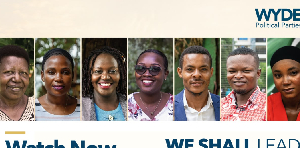 Some of the faces behind the documentary