The Parliamentary Select Committee on Water and Sanitation has described the Volta Region as the cleanest region it has visited so far during its ongoing monitoring of sanitation and waste management activities across the country.
The commendation was made on Friday, September 18, 2026, when the Committee visited the Ho Integrated Recycling and Compost Plant (IRECOP) at Akrofu-Agorve as part of the first day of its two-day monitoring tour of sanitation and waste management facilities in the Volta and Oti regions.
The Committee, led by its Chairman and Member of Parliament for Nkwanta North, John Oti Bless, was taken through the operations of the facility, including waste collection, processing, recycling and the conversion of organic waste into compost.
Speaking to the media after the inspection, Oti Bless said the visit formed part of the Committee’s oversight responsibility to assess the state of waste management infrastructure and engage operators and other stakeholders on challenges confronting the sector.
He said the Committee had so far visited about eight regions and observed significant sanitation challenges in several parts of the country. He, however, singled out the Volta Region for commendation, describing it as the cleanest among the regions visited.
“Among all the regions we have visited, Volta is the cleanest region so far,” Oti Bless said.
He also urged the media and other stakeholders to intensify public education and advocacy on sanitation to help address the country’s waste management challenges.
The Committee also heard concerns from the Jospong Group of Companies about infrastructure gaps affecting the effective operation of the Ho IRECOP.
The Group Head of Government Relations at the Environment and Sanitation Processing Cluster of the Jospong Group of Companies, Betty Brown Nyadu, identified the poor road network leading to the facility as a major challenge.
According to her, the poor condition of the access road could discourage waste operators from transporting waste to the facility and potentially contribute to the disposal of waste in nearby forests and farms.
She appealed to the government to construct the road to improve access to the plant and support efficient waste haulage.
Nyadu also called for the establishment of transfer stations at strategic locations closer to communities. She explained that such facilities would allow waste to be collected and consolidated before being transported to the IRECOP for processing and recovery.
She further appealed for policy support to create a reliable market for materials produced from processed waste.
She said about 60% of the waste received at the facility was organic and could be converted into compost or organic fertiliser to support agriculture in the region. She urged the government to consider measures to promote the procurement and use of locally produced materials.
Oti Bless assured the Jospong Group that the Committee would capture the concerns raised during the visit in its report to Parliament.
He specifically mentioned the poor road network and the need for transfer stations as issues requiring attention, adding that the Committee would engage relevant authorities, including the Ministry of Roads and Highways.
The Chairman also reaffirmed the Committee’s support for the proposed National Sanitation Authority Bill, saying stakeholders in the sanitation sector had expressed support for the establishment of a dedicated authority to strengthen sanitation management in the country.
The two-day monitoring exercise will continue with further engagements and assessments in the Volta Region before the Committee moves to the Oti Region.
Regional News of Friday, 18 September 2026
Source: Malik Bawa, Contributor
Parliamentary committee backs proposed National Sanitation Authority Bill
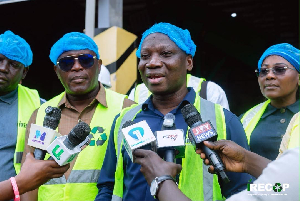 The Committee was led by its Chairman and Member of Parliament for Nkwanta North, John Oti Bless




Entertainment