Ghanaian political leader Johnson Asiedu Nketiah has used the inaugural Inter-Continental Dialogue on Political Parties in South Korea to challenge global political institutions, warning that established parties are failing to adapt quickly enough to retain the confidence of rapidly evolving societies.
Addressing the gathering on behalf of the African Political Parties Initiative (APPI), the National Chairman of Ghana’s National Democratic Congress (NDC) argued that declining public trust cannot be dismissed merely as a public relations issue.
Instead, he called for a critical examination of the quality of leadership political parties produce, their preparedness for governance and their connection to the everyday realities of citizens.
The landmark conference brought together major regional political blocs, including the Africa Governance Centre (AGC), through APPI; the International Conference of Asian Political Parties (ICAPP); and the Permanent Conference of Political Parties of Latin America and the Caribbean (COPPPAL).
Asiedu Nketiah commended the AGC for establishing APPI, which has created a structured platform for African political parties to engage with one another and their global counterparts.
The erosion of public loyalty and the social bargain
A central theme of Asiedu Nketiah’s address was the changing nature of public loyalty.
He noted that political parties once sustained by strong historical identities, generational ties or traditional ideologies are increasingly operating in environments where citizens are less willing to inherit political allegiances unquestioningly.
“A party’s history may explain the place it occupies in national life, but cannot guarantee its future,” Asiedu Nketiah stated, pointing out that younger generations, equipped with wider access to information and fewer institutional loyalties, are judging parties based on current economic and social conditions.
He warned of the consequences when citizens feel they have fulfilled their side of the social bargain by working hard, obeying the law and raising families, yet still find a decent standard of living out of reach.
He said when economic insecurity, unemployment and rising living costs collide with a lack of upward mobility, public frustration can develop into deep-seated scepticism about political institutions.
Beyond electoral competence: The call for rigorous leadership preparation
Drawing from his extensive career in grassroots politics, Parliament and national administration, Asiedu Nketiah cautioned against confusing electoral competence with readiness to govern.
“An organisation may understand mobilisation, campaigning and electoral strategy exceptionally well while remaining less developed in the policy, institutional and leadership capacities required once it assumes responsibility for government,” he said.
He urged political parties to place greater emphasis on cultivating leadership well before the opportunity to govern arises.
According to him, political organisations must possess enough institutional depth to ensure that the quality of governance does not depend on a narrow circle of personalities, thereby allowing for smooth leadership transitions without institutional crises.
Asiedu Nketiah also challenged political organisations to confront their failures rather than merely celebrate their successes.
He argued that electoral defeats, declining membership and difficult transitions should not be treated merely as temporary setbacks to be explained away or forgotten, but as important diagnostic tools for understanding why citizens withdrew their confidence.
The value of international dialogue and institutional depth
Reflecting on the purpose of the Inter-Continental Dialogue, Asiedu Nketiah highlighted the value of honest comparative learning across different political systems.
While noting that international exchange should not become an exercise in importing foreign political models, he maintained that exposure to diverse global experiences gives political leaders valuable perspectives for tackling domestic challenges.
Whether a party is transitioning from opposition to government, managing generational shifts or rebuilding after an electoral defeat, Asiedu Nketiah said opposition should be used as a period of serious policy preparation rather than political suspension.
He added that parties in power must constantly strive to remain connected to ordinary citizens.
As the inaugural Inter-Continental Dialogue concluded in South Korea, with plans to rotate future engagements across different regions, Asiedu Nketiah stressed that the initiative’s true success would lie in the enduring relationships built between participating institutions.
In a political landscape where citizens have alternative ways to organise and little patience for rigid institutions, Asiedu Nketiah’s message was that political parties must look beyond mere survival and actively demonstrate why they continue to deserve the public’s trust.
Regional News of Monday, 7 September 2026
Source: Eric Obeng Boateng, Contributor
Asiedu Nketiah challenges political parties to adapt to changing societies
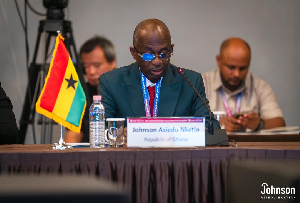 Picture of Johnson Asiedu Nketiah




Entertainment