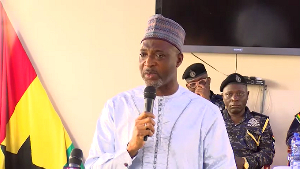
Namon Senior High Technical School (NASTECH) in the Offinso South Municipality of the Ashanti Region is set to benefit from free campus-wide Wi-Fi connectivity to support teaching, learning and internet access.
The initiative follows a pledge by UK-based alumnus Richard Agyare, who says the project will be funded by him with support from his wife, Mercy Dombo, as part of their shared commitment to promoting digital research and learning at his alma mater.
Agyare, who is known for his philanthropic activities in the Offinso South Constituency, disclosed this during a visit to the school on Wednesday, September 2, 2026.
He was accompanied by his wife and an entourage to present ceiling fans and an undisclosed cash donation to the school.
Speaking to reporters after the presentation, Agyare said his gesture was inspired by his personal experience as a former student and his concern about the persistent challenges facing the school.
“I was a student here, and I know the school lacked a lot in terms of infrastructure and equipment to support students' education,” he stated.
He recalled that when he graduated in 2001, the school faced severe dormitory shortages, forcing students to manually haul concrete blocks and fetch water to support the construction of accommodation facilities.
Agyare expressed disappointment that despite NASTECH’s recent impressive performance in the National Science and Maths Quiz (NSMQ), the school’s physical infrastructure, particularly its dining hall, had seen little improvement.
“Looking at the dining hall, I was deeply disappointed to see the environment where meals are prepared. It is unacceptable for a second-cycle technical institution,” he remarked.
He added that students deserved a clean, hygienic and modern environment.
According to him, apart from a few newly constructed classroom blocks, very little had changed since he left the campus 25 years ago.
“I thought that given their strong performance in national competitions, I would return to see significant government interventions or major stakeholder support,” he added.
Free Wi-Fi first
Outlining his roadmap for supporting the school, Agyare said the installation of free Wi-Fi would be his immediate priority, after which attention would be turned to accommodation and dining facilities.
“Free Wi-Fi is what we are tackling first. Once that is completed, we will look into the dormitories because the current situation is disheartening,” he noted.
He also pledged to engage the Namon SHTS Old Students Association, particularly the 2001 year group, which he said includes high-profile professionals, doctors and academics, to develop a structured intervention plan for the school.
He added that sharing the school’s achievements on social media had already generated interest among old students in the diaspora to support their alma mater.
Headmistress outlines severe challenges
Receiving the items, the Headmistress of Namon SHTS, Christiana Azumah Asore, expressed gratitude to Agyare, his wife and their delegation, describing the gesture as an exceptional display of patriotism.
“We are so excited because one of our past students, Richard Agyare, and his wife came to make this generous donation,” she said.
She noted that although the school occasionally receives support, Agyare’s intervention was particularly timely.
However, Asore used the occasion to highlight the severe infrastructural challenges affecting academic delivery, stressing that government resources alone could not meet the school’s growing needs.
“Government alone cannot cater for all these things, so we are appealing to philanthropists, past students, corporate entities, and citizens of Namon in the diaspora to come to our aid,” she pleaded.
She disclosed that the school’s student population had grown to more than 3,500, placing significant pressure on its existing facilities.
Among the major challenges she identified were a severe dining hall crisis, inadequate desks, the lack of a science laboratory and insufficient classroom furniture.
She also cited the school’s sickbay, which was constructed by the Parent-Teacher Association (PTA) and commissioned in 2024, as an example of what stakeholder collaboration could achieve.
Asore stressed that stronger partnerships among the government, past students, philanthropists, corporate organisations and other stakeholders remained critical to addressing the school’s infrastructure needs and providing students with a dignified learning environment.
Regional News of Thursday, 3 September 2026
Source: Nana Peprah, Contributor
NASTECH to benefit from free Wi-Fi as alumnus pledges support
 The initiative follows a pledge by UK-based alumnus Richard Agyare