The tidal waves that swept through the coastal communities of Agavedzi, Salakorpe and Amutinu in the Ketu South Municipality of the Volta Region since 2019 did not stop at the doorsteps of homes. They disrupted the livelihoods of families who depended on the sea and salt to survive.
Fish-smoking ovens were destroyed, livelihood materials were washed away or damaged, and caregivers who relied on fishmongering and salt mining suddenly found themselves without some of the basic tools they needed to earn an income.
For a fishmonger, the loss of an oven meant more than losing a piece of equipment. It meant being unable to smoke fish for the market. For a salt miner, the absence of salt-mining rubber made it difficult to carry out the activities needed to provide income for the household.
The disaster therefore left some caregivers facing the difficult task of rebuilding businesses that had been disrupted by forces beyond their control.
In a bid to alleviate their challenges, Friends of Adaklu (FOA) and its partner, Tectonic Movement, through the Sea Works At Night Project, have provided livelihood startup materials to 50 caregivers whose economic activities were affected by the tidal-wave disaster.
Rather than distributing the same items to everyone, the support was tailored to the livelihood activities of each caregiver.
The eight-month SEZ-Germany-funded project is a direct response to the devastating tidal waves that have affected the coastal communities in the area.
Twenty caregivers engaged in fishmongering received ovens and five oven meshes each, giving them the basic equipment needed to restore and strengthen their fish-processing activities.
Another 30 caregivers involved in salt mining received four rubbers each to support their salt-mining activities.
The Project Manager, Roberta Donkor, said the decision to provide livelihood materials was rooted in the needs created by the tidal waves.
She explained that the beneficiaries were not simply looking for assistance to start unfamiliar businesses, but had already built livelihoods around fish processing, fish trading and salt mining before the disaster disrupted their productive capacity.
“The assessment showed us that some caregivers had lost the very materials they depended on to make a living. If we want them to recover, we have to look at what they actually need to get back to work. That is why the support was targeted according to their livelihood activities.”
Roberta noted that replacing the ovens was particularly important for fishmongers whose smoking facilities had been destroyed, while the rubbers provided to salt miners would help address the material constraints affecting their daily operations.
She further noted that the materials should not be viewed as a one-off donation but as assets capable of generating income over time.
The project has also linked the material support with business management training to help caregivers make better decisions about their businesses, protect their capital and manage the income generated.
Speaking to the beneficiaries, Robert Tornu, Programme and Policy Advisor of Friends of Adaklu, urged the caregivers to make good use of the materials and protect them so that they could continue supporting their families beyond the immediate period of support.
He encouraged the beneficiaries to see the ovens and rubbers not simply as items received from a project, but as tools for rebuilding their businesses and generating income for their households.
Robert also stressed the importance of combining the materials with the business management skills the caregivers had acquired through the project. He encouraged them to manage their businesses carefully, keep proper records, protect their capital and reinvest where possible.
He expressed appreciation to SEZ and Tectonic Movement for their support and collaboration through the Sea Works At Night Project, describing the partnership as an important example of organisations working together to respond to the needs of communities affected by the tidal waves.
“We sincerely appreciate SEZ and the Tectonic Movement for this wonderful collaboration. Your support is reaching communities in a very practical way. We encourage the caregivers to make good use of what they have received so that these materials can continue to generate value for their families.”
Reacting to the gesture by FOA, one of the beneficiaries, Gifty Amegashie from Amutinu, expressed gratitude to Friends of Adaklu and its partners for remembering the people of Agavedzi, Salakorpe and Amutinu.
“When the tidal waves destroyed our livelihoods and left many of us struggling, they came to our aid by providing these items to help us rebuild our businesses and restore our livelihoods. We sincerely appreciate their support and kindness,” she said.
Regional News of Friday, 28 August 2026
Source: Desmond Tinana, Contributor
FOA restores livelihoods of 50 tidal wave-affected caregivers
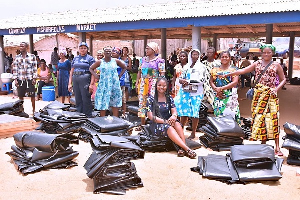 The disaster left some caregivers facing the difficult task of rebuilding businesses