The Member of Parliament (MP) for Ellembelle Constituency in the Western Region, Emmanuel Armah-Kofi Buah, has acknowledged the high standards set by Ghana’s first President, Dr Kwame Nkrumah, during his leadership of the country.
According to him, Dr Nkrumah’s influence was not derived from his position but from his willingness to sacrifice his comfort, safety, and freedom for the liberation of Africa.
"Nkrumah's authority never rested in his title. It rested in his willingness to sacrifice everything, including comfort, safety, and even his freedom for a continent that had not yet learned to believe in itself," he said.
"That is the inheritance I bring to this podium, and it is the same spirit I now ask each of you to carry to Nkroful, the birthplace of Osagyefo Dr Kwame Nkrumah, in September," he appealed.
Speaking at the launch of this year’s edition of NkrumahFest, the lawmaker reflected on the historic role played by the African icon in Ghana’s independence struggle and the liberation of the continent.
"One hundred and seventeen (117) years since a child was born in a small village of Nkroful—a child who would grow to rearrange the map of a continent and the conscience of a world. We gather today beneath the towering presence of this sacred mausoleum as living torchbearers of a vision that refuses to die," he remarked.
Buah commended participants for attending the launch of the programme, describing their presence as a demonstration of continued commitment to preserving Dr Nkrumah’s ideals.
"I thank you sincerely for honouring this call at such short notice. Your presence here is not just a gesture of respect but a declaration that the fire Kwame Nkrumah lit in our hearts still burns bright," he said.
He announced the launch of the 2026 edition of NkrumahFest, themed "A Journey to Nkroful," and described the annual pilgrimage to Nkroful as a sacred duty for all Ghanaians.
"This annual pilgrimage to Nkroful is our collective return to the very soil that gave birth to the man who gave birth to a nation," he stated.
The Ellembelle MP noted that he had been honoured to spearhead the initiative over the years, adding that each pilgrimage served as a reminder that Nkrumah’s legacy was not merely a monument to be admired but a mandate to be fulfilled.
"For years, I have been honoured to spearhead this initiative, and each year, as we prepare to walk the paths he once walked, I am reminded that Nkrumah's legacy is not a monument to be admired but a mandate to be fulfilled," he said.
He explained that the purpose of the celebration was to reignite public commitment to Dr Nkrumah’s vision.
"Let me state clearly why we are here. We are here to launch a movement. We are here to rekindle a revolution. We are here to declare that the dream Dr Kwame Nkrumah planted in the soil of Nkroful is not a relic of the past—it is the blueprint for our future," he added.
Buah announced that the main activities for the 2026 celebration would take place from September 14 to 21 in Nkroful, featuring lectures, cultural displays, community engagements, and moments of reflection.
"This year, as we celebrate his 117th birthday, we do so under a theme that is not merely descriptive but prophetic: ‘Nkrumah @ 117: Celebrating His Enduring Legacy – Africa Must Unite or Perish.’"
He described the theme as a call to action, rather than a mere slogan.
"‘Africa Must Unite or Perish’—these were not the idle words of a dreamer. These were the urgent words of a statesman who saw the future with terrifying clarity," he said.
According to him, Dr Nkrumah understood that Africa’s challenges could not be overcome through fragmented efforts by individual nations.
"He understood that our strength as Africans lies not in our borders, but in our bonds. He understood that our destiny is intertwined—that no African nation can truly be free until all of Africa is free," he noted.
Buah questioned whether Africans had fully embraced Dr Nkrumah’s vision beyond rhetoric.
"Have we heeded his warning? Have we embraced his vision? Have we moved beyond the rhetoric of Pan-Africanism to the reality of it?" he asked.
He stressed that celebrating Dr Nkrumah’s legacy required more than symbolic gestures, urging Ghanaians to build on the foundations he laid.
"To celebrate Nkrumah's enduring legacy is not to place wreaths at his feet while ignoring the foundations he laid. It is to build upon those foundations," he said.
He cited institutions and projects established under Dr Nkrumah’s leadership, including schools, factories, and the Akosombo Dam, as examples of initiatives whose relevance must continue to be assessed in shaping Ghana’s future.
"It is to look at the schools he built and ask: Are we educating our children for liberation or for subjugation? It is to look at the factories he established and ask: Are we building an economy that serves our people or one that serves distant masters?"
Buah concluded that Dr Nkrumah’s legacy remains alive in Ghana’s infrastructure, institutions, and the aspirations of citizens.
"His legacy lives in the roads we travel, the hospitals that heal us, and the industries that sustain us. But more importantly, his legacy lives in the spirit of every Ghanaian who dares to dream beyond their circumstances."
"That is the legacy we celebrate—not a man frozen in bronze, but a man whose ideas are still shaping our present and demanding our future," he added.
Regional News of Sunday, 2 August 2026
Source: Daniel Kaku, Contributor
Kwame Nkrumah's authority never rested in his title - Armah-Kofi Buah
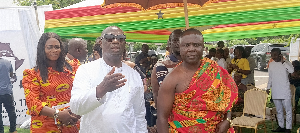 Emmanuel Armah-Kofi Buah, Minister for Lands and Natural Resources


Entertainment