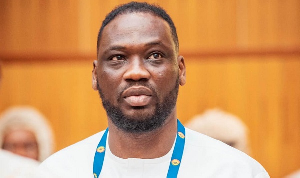
A longtime grassroots operative of the opposition New Patriotic Party, Abdul Ganiyu Mohammed — popularly known within party circles as “Bulldozer” — is positioning himself as a central figure in efforts to reorganize and strengthen the party in the Western Region following recent electoral setbacks.
Campaign materials circulating within the party project Mohammed as a tested political organiser whose rise through the ranks reflects nearly three decades of involvement at multiple levels of the NPP structure, from polling stations to the national executive space.
Using the slogan, “Built to Rebuild,” the campaign frames his candidacy around party restructuring, grassroots mobilisation, and electoral recovery.
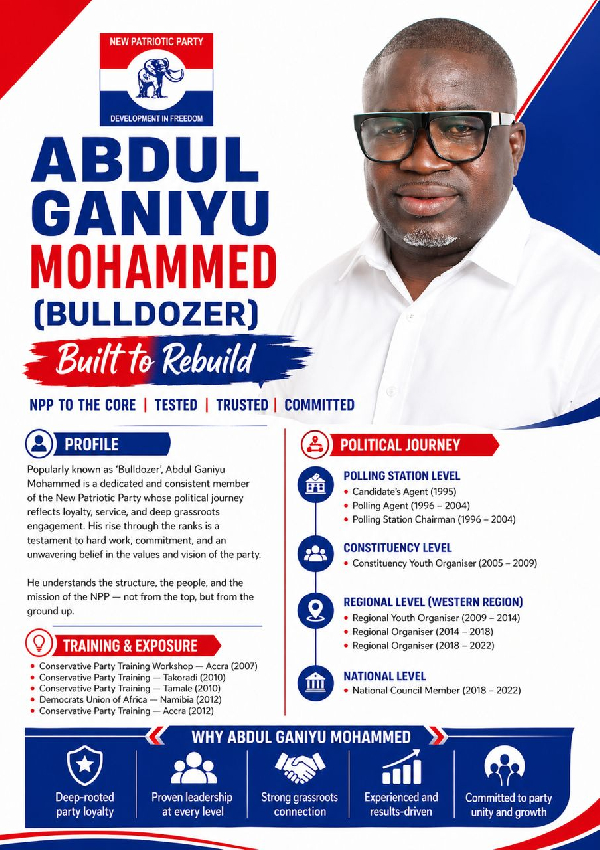
According to campaign documents available to GhanaWeb, Mohammed’s political journey began at the polling station level in 1995 as a candidate’s agent before later serving as polling agent and polling station chairman between 1996 and 2004.
He subsequently moved into constituency politics, serving as Constituency Youth Organiser from 2005 to 2009 before rising to the regional front of the party in the Western Region.
Mohammed also served as Regional Youth Organiser from 2009 to 2014 and later as Regional Organiser from 2014 to 2018, a role he reportedly retained from 2018 to 2022. He also served as a National Council Member between 2018 and 2022.
The campaign portrays that progression as evidence of what it calls “deep-rooted party loyalty” and “proven leadership at every level.”
Central to Mohammed’s message is a pledge to rebuild the party’s electoral fortunes in the Western Region.
The campaign claims he played a significant role in the NPP’s 2016 parliamentary performance in the region, during which the party reportedly increased its parliamentary seats from eight to sixteen.
His stated vision includes increasing the party’s parliamentary representation in the Western Region from minority to majority status, consolidating grassroots structures, and expanding the party’s appeal among middle-class voters, tertiary students, and young professionals.
The campaign also emphasises “results-driven leadership” and party unity as key pillars of his political philosophy.
One of the campaign flyers states that Mohammed understands the structure and mission of the NPP “not from the top, but from the ground up,” portraying him as a bridge between the national hierarchy and the party base.
The “Bulldozer” branding appears carefully crafted to reinforce an image of resilience, organisational toughness, and relentless grassroots engagement.
The materials repeatedly stress his long-standing relationship with polling station executives and constituency organisers — a critical bloc in internal party elections.
Political analysts say such messaging is often aimed at persuading delegates that practical organising experience matters more than elite political visibility, especially at a time when the NPP is seeking internal cohesion and regional recovery strategies.
The campaign also places heavy emphasis on youth engagement and party expansion, with promises to empower tertiary students and young professionals while strengthening traditional grassroots networks.
Mohammed’s campaign additionally highlights a number of political training programmes and international exposures, including Conservative Party workshops held in Accra, Takoradi, Tamale, and Namibia between 2007 and 2012.
The inclusion of those credentials appears intended to reinforce an image of administrative preparedness and ideological grounding within conservative political traditions.
The emergence of Mohammed’s campaign comes at a period of heightened introspection within the NPP as the party assesses its future direction and regional strategy ahead of upcoming internal contests and national political reorganisation.
Within the Western Region — traditionally regarded as one of the NPP’s important electoral strongholds — discussions about rebuilding structures, energising the base, and reconnecting with younger voters have become increasingly prominent.
Mohammed’s message appears designed to tap directly into those concerns, presenting himself as an experienced organiser capable of reconnecting the party to its grassroots machinery while restoring competitiveness in the region.
With slogans such as “Built from the grassroots. Tested through experience. Ready to rebuild and win,” the campaign is clearly attempting to position Abdul Ganiyu Mohammed not merely as another party executive aspirant, but as a symbol of reconstruction within the NPP’s regional political architecture.
Former Asante Akim North MP breaks silence on MP OK Frimpong’s ‘arrest’
Regional News of Friday, 15 May 2026
Source: www.ghanaweb.com
NPP’s ‘Bulldozer’ promises youth-focused restructuring in Western Region
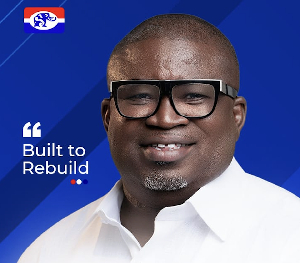 Abdul Ganiyu Mohammed believes the youth are the future of the NPP