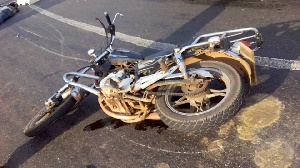
New data released by the National Road Safety Authority (NRSA) has revealed an alarming surge in motorcycle involvement in road crashes this year.
The figures show a 19.1 per cent increase between January and October 2025 compared to the same period in 2024.
The statistics underscore growing concerns raised by road safety advocates regarding inadequate infrastructure and regulatory gaps affecting vulnerable road users.
According to the NRSA data for January to October 2025, a total of 5,503 motorcycles were involved in crashes, up from 4,452 during the corresponding period in 2024.
Motorcycles now account for 26.6 per cent of all vehicles involved in crashes, an increase from 23.6 per cent the previous year.
This spike occurs amidst a broader crisis where overall traffic fatalities rose by 20 per cent in the first eight months of 2025 alone.
Motorcyclists, along with pedestrians and passengers in commercial vehicles, are among the most frequent victims of fatal crashes.
Experts warn that this escalation is exacerbated by Ghana’s failure to adapt its overall road infrastructure to changing mobility trends.
While the number of motorcycles has moved up by over 1,500 per cent in recent years, roads largely remain designed exclusively for cars and trucks.
Speaking in an interview with GNA, Enock Jengre, a Private Legal Practitioner and Programmes Officer at the Legal Resources Centre (LRC), criticized this systemic flaw, noting that the absence of dedicated lanes forces motorcycle, tricycle, and bicycle riders into dangerous interactions with larger vehicles, increasing crash risks.
Beyond infrastructure, he noted that speeding remains the primary contributor to collisions, underlying over 60 per cent of crashes nationwide.
Motorcycles were also identified as topping the list of speeding vehicles in the national capital, Accra, recording a 57 per cent speeding rate in September 2024, pursuant to the data released by the NRSA.
The soaring crash rates have intensified calls for immediate legislative action, particularly concerning motorcycle helmet standards.
The NRSA reported over 1,500 motorcycle crashes in the first half of 2025 alone, with 1,575 incidents specifically recorded between January and June 2025.
Despite existing laws mandating helmet use, Jengre, stressed that Ghana lacks defined standards specifying acceptable or safe helmet types, a gap that is costing lives.
“We are advocating for these standards to be mandatory. Optional standards will not solve the problem,” Jengre said.
The Ghana Standards Authority (GSA) is leading National Standards Committee for Automobile of which the LRC is a member, with support from the Bloomberg Initiative for Global Road Safety (BIGRS).
The committee has so far developed draft standards for motorcycle crash helmets which would be gazetted soon, according to Jengre.
These proposed Ghana-specific standards aim to address local conditions like weather and road networks, recommending features like white helmets for enhanced nighttime visibility over black ones.
Even though the Parliament of Ghana passed the Road Traffic (Amendment) Bill into law on Thursday, 11 December 2025, now awaiting presidential assent, Jengre maintained that Ghana must be intentional in its approach.
He stated that concerted efforts were needed to effectively regulate the use of motorcycles for commercial purposes.
He called on the GSA, the Driver Vehicle Licensing Authority, the Ministry of Transport, the National Road Safety Authority and the Ghana Police Service, as well as city authorities among others to effectively collaborate to ensure that there were demarcations and boundaries set for motorcycle and tricycle operations.
Jengre noted that tackling the rising motorcycle fatality rate required a coordinated effort, emphasising that road safety is a “public health emergency.”
He said the solution involves stronger laws, safer roads, re-engineering and re-designing of Ghana’s roads, safe system approach, and comprehensive enforcement.
Denis Yeribu, Principal Planning Manager at the NRSA, reiterated the critical role of enforcement, noting that education alone was insufficient unless people faced “real consequences for violations.”
As Ghana continues to record at least eight road deaths daily, safety advocates maintain that deliberate investment in safer road infrastructure, mandatory standards, and stronger institutional enforcement were essential to prevent the crisis from deepening.
Regional News of Monday, 29 December 2025
Source: GNA
Motorcycle crashes surge 19.1% in 2025, experts demand action now
 The figures show a 19.1 per cent increase between January and October 2025 compared to the same per