Correspondence from the Eastern Region
Traditional leaders, government institutions and civil society organisations have renewed a collective commitment to curb teenage pregnancy and harmful practices including end child marriage in the Eastern Region, following a high-level stakeholder workshop held in Koforidua.
The two-day workshop, organised by the Obaapa Development Foundation on Friday 19 and Saturday December 20 2025, brought together chiefs, queenmothers, religious leaders, youth and women leaders, as well as representatives from education, health, gender, social welfare DOVVSU and other partner institutions at the Capital View Hotel.
The engagement focused on strengthening leadership and community-based action to prevent teenage pregnancy and eliminate harmful practices, particularly child marriage, within the New Juaben Traditional Area and beyond.
Opening the workshop, Nana Twumasi Darkwa, Gyaasehene of the New Juaben Traditional Area called for a united societal response to injustice against children.
He urged participants to engage communities, educate the youth and empower women and children to break cycles of poverty, inequality and abuse. “Let this generation be the one that says enough is enough,” he said, adding that every child deserves the opportunity to grow, learn and flourish.
Adding his voice, Paramount Chief of the New Juaben Traditional Area, Daasebre Kwaku Boateng III as chairman of the occasion, placed the primary responsibility for child care at the doorstep of parents and blamed weak parental supervision for the persistence of teenage pregnancy.
He stressed that families must take greater ownership of their children’s moral, educational and social development, warning that community and institutional interventions would yield limited results without responsible parenting at the household level.
Richard Obeng Boafo, Deputy Director at the Ministry of Local Government, emphasised the strategic role of traditional authorities as custodians of culture, justice and community values.
He noted that chiefs have a constitutional mandate to review and eliminate outdated customs that harm children, including child marriage and other negative gender norms.
Boafo underscored the importance of partnerships between government, traditional leaders and civil society organisations such as Obaapa Development Foundation, UNFPA and International Needs Ghana.
He highlighted progress made in 2025, including engagements with the National House of Chiefs, training of Traditional Council registrars and collaboration with faith-based organisations.He also stressed that sustained advocacy, survivor support services and community accountability remain critical to ending harmful practices.
The Eastern Regional Director of Gender, Moses Tettey Keney, described child marriage as a serious violation of children’s rights to education, health, protection and choice.
He presented data from national surveys indicating that over 27 per cent of women aged 20–49 in the Eastern Region were married before the age of 18, while 1 per cent of children aged 12–17 in the region have already entered marriage or unions. “There is no excuse for child marriage,” he stressed, reminding participants that the practice is illegal under Ghana’s Children’s Act (Act 560).
From the education sector, a presentation delivered on behalf of the Eastern Regional Education Directorate highlighted teenage pregnancy as a major contributor to school dropout, delinquency and early marriage.
While teenage pregnancy in the region declined by nearly 29 per cent between the 2023/24 and 2024/25 academic years, some girls continue to leave school due to stigma, health challenges and financial difficulties, underscoring the need for sustained interventions and enforcement of school re-entry policies.
The Eastern Regional Health Directorate also warned of the serious health implications of teenage pregnancy and child marriage, including increased risks of maternal mortality, obstetric complications, mental health challenges and poor outcomes for newborns.
Although adolescent pregnancies declined from 10,383 in 2022 to 8,638 in 2024, low uptake of family planning services among adolescents remains a concern.
Participants identified poverty, weak parental guidance, harmful cultural norms, peer pressure and limited access to sexual and reproductive health services as key drivers of both teenage pregnancy and child marriage.
Traditional leaders acknowledged their responsibility as change agents capable of enforcing declarations, protecting girls’ education and promoting positive cultural values.
The workshop concluded with commitments to strengthen family support systems, intensify community education, enforce laws against child marriage and ensure prompt reporting of cases to appropriate institutions.
Participants agreed that ending child marriage is a long-term process requiring consistent collaboration among families, traditional authorities, government institutions and civil society to safeguard children’s rights and secure Ghana’s development future.
Regional News of Wednesday, 24 December 2025
Source: www.ghanaweb.com
Traditional leaders, state agencies rally against child marriage in Koforidua
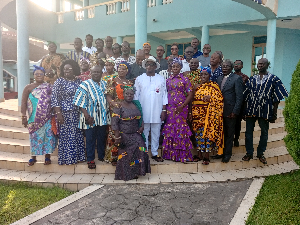 Daasebre Kwaku Boateng (in white) flanked by other participants at the workshop