Members of the media fraternity and civil society organisations (CSOs) have been encouraged to play an integral role in the fight against corruption and asset recovery in the country as part of their contributions towards the country’s fight against corruption.
Urging the groups to participate in the campaign through investigative journalism, public sensitisation, and contributing to legislative reforms, Bridgett Nadia Barnor, fraud investigator at Economic and Organized Crime Office (EOCO) indicated that collective action remains the most effective approach to combating corruption and recovering stolen assets, emphasizing the FIC's openness to collaborate with journalists, development partners, and advocacy groups in building a corruption-free society.
She made the call during a one day workshop organized by the Ghana Anti-Corruption Coalition (GACC), in collaboration with the Economic and Organized Crime Office (EOCO) and the Financial Intelligence Center (FIC), on asset recovery and management at Ada in the Greater Accra Region.
The event organized with funding support from the Inter-Governmental Action Group Against Money Laundering in West Africa, brought together about twenty journalists from the print, electronic and online categories.
The engagement formed part of the GACC project: Building Political Will and Public Support for Asset Recovery in Ghana,” with the objective of deepening the public understanding and strengthening the role of the media and civil society in advancing Ghana’s asset recovery efforts.
Themed; “Ghana’s legal and institutional frameworks for recovery proceeds of crime and highlight the role of citizens and the media in asset recovery,’ the fraud investigator while noting that EOCO needs a good collaboration with the media and CSOs to educate and sensitise the public on its mandates as well as the effect of crime on the community and the country said the organization was empowered by the office of the Attorney-General (AG) to prosecute most of its cases.
Sensitising participants on the mandate of the EOCO on asset recovery and management, the EOCO official noted that the media and CSOs play a crucial role in reporting on the mandates and duties of these agencies to the public, reiterating that the Office was building on the collaboration and cooperation with the media and other stakeholders on crime issues and asset recovery.
She urged the two entities to prioritize their education and sensitisation on the mandates and duties of the EOCO, FIC and other law enforcement agencies on corruption-related issues, asset recovery and management.
Raphael Asamoah, a representative from the Financial Intelligence Centre (FIC) said asset recovery, which involves the confiscation and return of illegally acquired assets to the state or rightful owners, was essential to address the drain of national resources caused by money laundering, fraud, tax evasion, and other forms of economic crime.
Reiterating the Centre’s central role in Ghana's asset recovery efforts, he urged stronger collaboration with the media and civil society organisations (CSOs) to intensify the fight against corruption and illicit financial flows.
According to him, Ghana's asset recovery regime aligns with global standards set by the United Nations Convention Against Corruption (UNCAC), the Financial Action Task Force (FATF), and the ECOWAS Protocol on Anti-Corruption, adding that domestically, it is supported by laws such as the Anti-Money Laundering Act, the Economic and Organised Crime Office (EOCO) Act, and the Office of the Special Prosecutor Act.
The FIC's mandate includes freezing assets suspected to be linked to criminal activities and collaborating with EOCO, the Office of the Special Prosecutor (OSP), the Ghana Police Service, and international partners.
Ghana, as of June 2024, had frozen cash assets valued at GH¢5,095,869.78 and over US$11 million, pending prosecution outcomes, while in 2023 alone, 42 money laundering convictions were recorded, primarily related to fraud, forgery, and drug trafficking.
Underscoring the role of non-state actors, he referenced Article 13 of the UNCAC, which calls on state parties to promote the involvement of civil society and media in preventing and combating corruption.
Regional News of Saturday, 5 July 2025
Source: Michael Oberteye, Contributor
Media and CSOs encouraged to play active role in anti-corruption fight, asset recovery
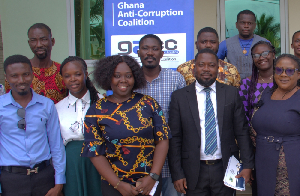 The media participants at the event in a group photo