Correspondence from the Eastern Region
The Kyidomhene Ahunabobrim Akuamoah Kwao II of Boso-Gua Traditional Area in the Eastern Region has appealed to government and other key stakeholders to harness the vast potential in Boso-Gua’s tourism sector as a strategic tool not only to create employment but also address economic challenges facing the nation.
Ahunabobrim Akuamoh Kwao II speaking in an interview during the ancestral funeral of the 25 deceased chiefs and a queen mother pointed out that tourism was the most accessible and effective avenue to attracting both local and international investments.
He emphasized that tourism not only served as a source of revenue generation but also had the capacity to create jobs, promote local culture, and open up rural communities to development opportunities.
Appealing to the government and the President to harness the town’s tourism, he expressed: “Boso, we’re now coming up, so government should set his eyes, his satellite on Boso, they should trust us, we’re ready to cooperate with government, we have the Volta river passing through , we have the people who understand tourism.”
Underscoring the essence of the ancestral funeral, Ahunabobrim Akuamoh Kwao II said there was the need for unity. He said, “This is not just about culture, but it’s about the unity that we find ourselves in [in] the community,” he observed.
The Kyidomhene eulogizing his predecessors stated: ”Over the course of 25 illustrious reigns, these chiefs have navigated challenges and championed initiatives that have helped and shaped our community into what it is today.”
Extolling the role culture plays in modern society, he emphasized that it was necessary to continue with the customs and traditions left behind by the ancestors, an ambition he disclosed was rooted in the idea behind the ancestral funeral.
According to him, the lack of guidance for today’s youth was responsible for their waywardness. He observed, “Now the youth are being left alone, society being left alone, people don’t care about each other, we have neglected our youth but that is not our culture, our culture is togetherness, our culture is unity.”
He attributed the establishment of the Boso-Gua community to its first chief, Nana Akuamoah Kwao, noting that it was a legacy worth celebrating.
“They’ve left a community in my hands, they’ve left a community of unity, they’ve left a community of prosperity, they’ve left a community of a brighter future and I’ve to pick it up and continue.”
About the ancestral funeral
The one week event observed from Monday, July 14 to Sunday, July 20, 2025 ensured a befitting final funeral rites for the late chiefs, from Ahunabobrim Akuamoah Kwao II through Ohemaa Nene Asantewaa Aburam I to Nana Ansah Asuman II whose reign lasted from 1998 to 2019.
The event saw the final funeral rites being observed for the 25 late chiefs and one queen mother of Boso-Gua who had passed on since the 1700s.
Though many chiefs were installed in the past, final funeral rites for deceased predecessors were not conducted, necessitating a grand occasion to bid a befitting farewell to all the late rulers who contributed to and left behind various legacies for Boso-Gua and its people.
Explaining the essence of the occasion, Seth Junior Obeng-Frimpong, a royal from the Amoakarle family noted: “It is imperative that in any traditional setting, as you do the burials, you take steps to do the funerals, it paves way for so many other things…so far as the Amoakarle family, having the Kyidomhene as part of us, we thought it wise to do the ancestral funeral for all of our past chiefs, not for only Kyidomhenes who have come and gone but the various sub-chiefs in the Amoakarle family.”
According to him, it was imperative for Ghanaians and the world to know the true identity of Boso-Gua. “We want people to know what Boso stands for,” he stated.
Moses Danso Aburam, Amoakarle Abusuapanyin in a tribute to Amoakarle Ancestry said, “Each chief has walked the path of service, paving the way for future generations to inherit a legacy rooted in respect, dignity and communal pride.”
The activities involved a visit to the ancestral home and engagement with nananom edikanfo, traditional performance of traditional rites and nsiesie edwumadi, nananom akomfo agorodee kese, traditional performances by various asafoatses, a night vigil with cultural performances, tete amamere and abakosem, among other events.
Notable traditional leaders including the Paramount Chief of Peki Traditional Area, Deiga Kwadzodeh Dei XII, Paramount Chief of Anfoeta, Togbe Kwasi Drah VII, Paramount Chief of Kpalime, Togbega Atikpladza Agbi Yao VIII, Paramount Chief of Anum Akusiaku Brempong Kumi Sasraku VIII, Paramount Chief of Dodowa Nene Okukrubour Tei Kwesi Agyemang V queen mother of Boso-Gua Traditional Area Nene Abena Sefaa I queen mothers among many royals from the Volta and Eastern Regions, joined scores of mourners to give the late chiefs a befitting farewell.
Also, in attendance were politicians, the clergy, and other mourners from all walks of life.
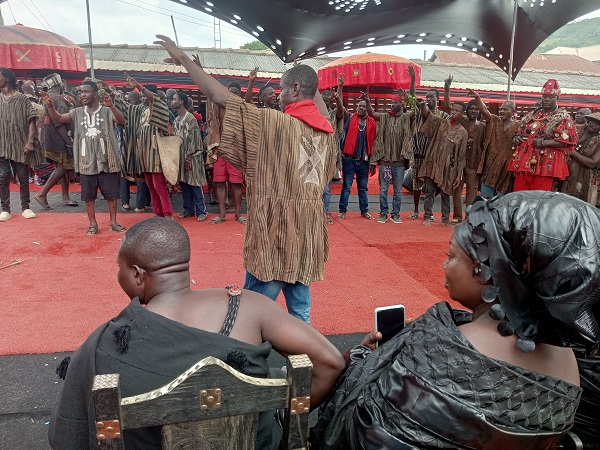
The event turned the Boso-Gua Township into a state of sorrow as the royals mostly clad in red and black apparel and traditional regalia, sang dirges, and paraded the community.
Traditional warriors were also not left out of the ceremonies with the sporadic firing of musketries.
The elaborate event reflected the high status of the late chiefs and their connection to ancestors.
The ceremonies involved unique rituals and customs, including the use of traditional music, attire, and symbols which wasn’t just a farewell but a way to honor the deceased’s’ lineage and ensure their smooth transition to the spirit world.
Despite the grief, the atmosphere fostered an air of unity with indigenes of Boso-Gua from far and near returning home and converging at the community durbar grounds for the occasion.
Regional News of Monday, 28 July 2025
Source: www.ghanaweb.com
Kyidomhene of Boso-Gua Traditional Area promotes tourism
 Ahunabobrim Akuamoh Kwao II seated in his palanquin