The Ghana Meteorological Agency (GMet) has organized a one-day training workshop in Koforidua to strengthen the capacity of journalists in the Eastern Region to communicate weather-related information more effectively to the public.
The training, held at the Capital View Hotel, formed part of a three-phase Media Engagement Sensitization Workshop on Early Warning Systems (EWS) being rolled out by GMet’s Central Analysis and Forecast Office (Public Weather Unit).
The initiative, themed “Advancing Early Warning Systems for All: Media as a Lifeline,” seeks to deepen collaboration between meteorologists and media professionals to ensure the timely and reliable dissemination of weather forecasts and climate information.
Bridging the Gap in Early Warning Systems
Globally, meteorologists note that early warning systems often fail to trigger prompt responses at the community level due to delays in communication and difficulties in translating forecasts into actionable steps.
The workshop therefore targeted reporters from print, broadcast, and online platforms to help close this communication gap.
Participants received expert-led training on marine and public weather services, impact-based forecasting, and practical strategies for reporting during extreme weather events.
Media’s Role in Building Resilience
Opening the session, Dr. Ignatius Kweku Williams, Acting Deputy Director-General of Operations at GMet, underscored the importance of the media in safeguarding lives.
“Early warnings only save lives when they are timely, accurate, and understandable. The media is our bridge to the public,” he said.
Felicity Ahafianyo, Head of GMet’s Central Analysis Unit, provided an overview of Ghana’s climate patterns and highlighted climate data spanning 1976 to 2018, which shows that Ghana’s annual rainfall ranges between 700mm and 2,030mm, with average temperatures between 22°C and 32°C.
Ahafianyo further stressed the links between climate variability and public health, warning of increased disease risks. She called for stronger public education campaigns through radio, television, community platforms, and faith-based institutions.
Tackling Challenges in Climate Communication
Senior meteorologists, including Joshua Asamoah, Thomas Biney, and Esther Egbuka, led technical sessions on GMet’s services and presented forecasts for the minor rainfall season in southern Ghana.
'Move to higher grounds, more rains expected' – GMet warns residents of flood-prone areas
Discussions also addressed common challenges such as misinformation, limited access to meteorological data, and the need for stronger collaboration between the media and scientists.
Part of a Larger National and Global Agenda
The workshop forms part of GMet’s broader strategy to embed the media within Ghana’s early warning framework, with similar training sessions planned in other regions.
It also aligns with the United Nations’ Early Warning for All (EW4All) initiative, which aims to ensure that by 2027, everyone worldwide is protected from hazardous weather, water, and climate events through accessible, life-saving early warning systems.
Research shows that such systems are among the most cost-effective disaster risk reduction and climate adaptation tools, delivering up to a tenfold return on investment.
The first leg of the engagement series was held in Accra, bringing together news editors, producers, show hosts, and digital content creators to enhance their skills in interpreting and disseminating weather forecasts.
GhanaWeb's latest documentary, Sex for Fish, that explores the plights of teenage girls in coastal communities, all in an attempt to survive, is out. Watch it below:
Regional News of Sunday, 31 August 2025
Source: Michael Oberteye, Contributor
GMet trains journalists in Eastern Region on early warning systems
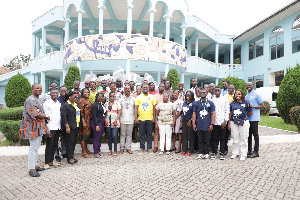 Some journalists who were trained by GMet