Despite the launch of the African Continental Free Trade Area (AfCFTA), many women-led businesses across the continent remain unable to fully benefit from the agreement due to structural barriers that continue to limit cross-border participation, Managing Director of Access Bank Ghana, Pearl Nkrumah, has said.
Speaking at the 2026 Africa Prosperity Dialogues on Wednesday, February 4, Ms Nkrumah argued that Africa’s trade ambitions will fall short unless systems are deliberately designed to support the categories of traders that dominate informal and small-scale commerce, particularly women and young entrepreneurs.
According to her, while AfCFTA promises a unified African market, its success will ultimately be measured by how easily small businesses can trade across borders, collaborate regionally and access finance without excessive friction.
“Payment is very critical because when there’s no payment, trade is very slow in everything that we do,” she said, noting that unresolved settlement bottlenecks disproportionately affect women traders who lack the buffers available to larger corporates.
Ms Nkrumah explained that many African businesses still face delays and cost overruns because cross-border transactions often require foreign currency settlement, a challenge that weakens cash flow and discourages expansion into new markets.
“For me, the fact that after it’s all said and done, I still need to settle in US dollars is where the problem is,” she said, adding that a system where local currencies can move seamlessly across borders would significantly improve participation for smaller enterprises.
She pointed to initiatives such as the Pan-African Payment and Settlement System (PAPSS) as steps in the right direction, but stressed that stronger political will is needed to ensure that implementation keeps pace with policy declarations.
Beyond finance, the Access Bank MD highlighted the importance of platforms that enable women traders to connect, scale and integrate into regional value chains; moving beyond subsistence trading into structured commercial activity.
She noted that Access Bank has sought to support this transition through its AccessAfrica platform, which allows customers across the bank’s African footprint to transact more efficiently and, in some corridors, in local currency.
The discussion formed part of a broader conversation on women’s leadership in Africa’s economic future, bringing together senior figures from government, academia, business and civil society.
Vice-Chancellor of the University of Ghana, Prof. Nana Aba Appiah Amfo, drew attention to the digital skills gap that continues to undermine women’s competitiveness in cross-border trade, noting that low digital visibility remains a major constraint for informal traders.
“It doesn’t matter what a student studies; if they are not digitally literate when they graduate, survival in today’s economy will be difficult,” she said.
From the private sector, Executive Chair of Plot Enterprises, Patricia Poku Diaby, warned that African producers remain trapped in low-value trade due to weak regional integration, citing cocoa as an example of how fragmented policies and border inefficiencies erode competitiveness.
Deputy Chief of Staff at the Office of the President, Nana Oye Bampoe Addo, called for deliberate government action to simplify border procedures and digitise customs systems, stressing that AfCFTA must deliver tangible change for women in business.
Press Releases of Thursday, 5 February 2026
Source: Access Bank
Women-led enterprises still locked out of AfCFTA gains - Pearl Nkrumah
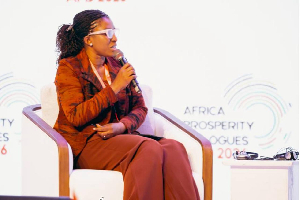 Pearl Nkrumah is the Managing Director of Access Bank Ghana