As the New Patriotic Party (NPP) considers the leadership combination that could strengthen its prospects in the 2028 general election, the question of who should partner its flag bearer, Dr Mahamudu Bawumia, deserves careful consideration.
Among the personalities whose credentials merit attention is Dr Nana Yaw Ayew Afriye, the Member of Parliament for Effiduase-Asokore in the Ashanti Region. A medical doctor, healthcare entrepreneur and experienced legislator, Dr Afriye offers a combination of professional knowledge, parliamentary experience and political engagement that could make him a compelling candidate for the vice-presidential slot.
His strongest argument may lie not only in his professional and legislative background but also in the qualities that supporters associate with his political style: accessibility, persuasive public speaking, the ability to attract crowds and a capacity for grassroots mobilisation.
For a party seeking to reconnect with voters, strengthen its communication and present a convincing national message, these qualities could prove particularly valuable.
Closing the communication gap
One of the central challenges facing any presidential campaign is the ability to translate policy proposals into messages that ordinary citizens can understand, relate to and trust. A candidate may have sound policies and an ambitious development agenda, but those proposals must be communicated effectively to voters across different communities and social groups.
This is where Dr Afriye’s candidacy could make a difference.
The ideal running mate for Dr Bawumia should be someone who complements the flag bearer’s strengths, reinforces the party’s message and helps bridge the gap between policy formulation and public understanding. Such a person must be able to explain complex issues in accessible language, respond confidently to criticism and provide party communicators with a clear, consistent message to take to the public.
Dr Afriye’s supporters point to his public-speaking ability and political accessibility as qualities that could serve this purpose. If deployed effectively on a national campaign platform, these attributes could help the NPP communicate its policies more persuasively and improve the coordination between its leadership, communicators and grassroots structures.
The objective would not be to replace the party’s existing communication machinery but to strengthen it with a running mate who can reinforce its message, clarify difficult issues and help communicators respond coherently to public concerns.
An accessible politician with grassroots appeal
Accessibility is an important quality in public leadership. Voters are more likely to engage with political leaders who are willing to listen, interact with communities and respond to concerns beyond election periods.
Dr Afriye is described by his supporters as an accessible politician whose engagement with party members and grassroots organisers has helped establish his political presence. His constituency work and participation in party activities provide a foundation on which a broader national political role could be built.
His approach to grassroots mobilisation is another consideration. A successful running mate must do more than address large rallies; the person must also help organise polling-station structures, motivate constituency executives, engage identifiable groups and encourage party supporters to translate enthusiasm into votes.
In August 2020, Dr Afriye launched the “Operation 90/90” campaign initiative in Effiduase-Asokore, setting an ambitious electoral target for the constituency. The initiative illustrated his willingness to mobilise local party structures around a defined campaign objective.
That experience is relevant to a national campaign in which organisational discipline, voter contact and constituency-level coordination will be critical.
Supporters who describe him as a crowd-puller argue that his ability to attract and energise audiences could also benefit the NPP. While crowd sizes alone cannot guarantee electoral success, the ability to draw people, hold their attention and motivate them to participate in political activities can contribute to campaign visibility and morale.
A communicator who could strengthen the party’s message
The NPP’s next presidential campaign will require a communication strategy that is clear, consistent and responsive to public concerns. The running mate must be able to work with the flag bearer, party leadership, parliamentary representatives and communicators to ensure that the party speaks with clarity and purpose.
A communication gap can emerge when campaign leaders articulate a position that party spokespersons struggle to explain or defend. Conflicting explanations can create uncertainty among supporters and weaken the credibility of a political message.
Dr Afriye’s supporters believe his public-speaking skills and political experience could help address this challenge. As a legislator who has participated in parliamentary debates and party discussions, he has experience engaging with issues that require explanation, argument and public defence.
His potential value would therefore extend beyond delivering speeches at rallies. He could help translate policy positions into practical messages, anticipate difficult questions and ensure that party communicators have the information and arguments needed to engage the public confidently.
However, the effectiveness of such a role would depend on close coordination with Dr Bawumia and the party’s communication leadership. A running mate must complement the flag bearer’s voice rather than create a competing centre of messaging.
Medical expertise and parliamentary experience
Dr Afriye’s professional background provides another basis for considering his candidacy.
According to the Parliament of Ghana’s official profile, he obtained his medical qualification from the University of Ghana Medical School in 2004. He subsequently earned a master’s degree in Economic Policy Management from the University of Ghana in 2009, a master’s qualification in Public Health from the University of Leeds in 2011, and a postgraduate certificate from the University of Oxford in 2012.
His professional experience includes work at Ridge Hospital, where he served as Head of Institutional Public Health, and leadership of St John’s Hospital and Fertility Centre as chief executive officer.
These experiences have given him exposure to clinical practice, healthcare administration and questions surrounding the delivery and management of health services.
His parliamentary career has also included leadership of Parliament’s Select Committee on Health during earlier parliamentary terms. In the Ninth Parliament, he serves as Ranking Member of the Health Committee and is also a member of the Petitions Committee.
This combination of professional and legislative experience could strengthen the NPP’s ability to discuss healthcare delivery, health financing, public-sector management and social development. It would also give the party an experienced voice on issues that directly affect households and communities.
Although technical expertise alone does not determine a successful vice-presidential candidate, it can provide a useful foundation for policy discussions and public engagement.
A connection to the party’s youth and organisational structures
The strength of a political party depends partly on its ability to maintain relationships with its grassroots membership and develop the next generation of leaders.
In September 2026, Dr Afriye was reported to have been named patron of the NPP’s Ashanti Regional Youth Wing. The reported recognition was linked to his support for youth activities and engagement with the party’s youth structures.
For a party seeking to motivate its members and improve its organisational readiness, such relationships could be useful. Young people are important participants in political campaigning, community outreach, voter education and the mobilisation of support.
A running mate who can engage youth organisers while maintaining relationships with experienced party officials may help bring different segments of the party together around a common campaign objective.
Dr Afriye’s supporters could therefore make the case that his political appeal is not confined to parliamentary debates or constituency engagements but also includes participation in the party’s wider organisational life.
Why he could complement Dr Bawumia
The choice of a running mate should be guided by complementarity rather than personal popularity alone. The question is whether the prospective candidate can add qualities, relationships and experience that strengthen the presidential ticket.
For Dr Bawumia, Dr Afriye’s potential contribution would be built around four considerations: accessible leadership, persuasive communication, grassroots mobilisation and experience in healthcare policy and parliamentary affairs.
These attributes could help the NPP build a campaign that connects national policy arguments with the everyday concerns of voters. They could also help reinforce communication discipline, particularly when party members must explain policy decisions, respond to criticism and defend the party’s record.
The Ashanti Region, where Dr Afriye represents Effiduase-Asokore, is also an important political arena for the NPP. His constituency experience and connections within regional party structures could offer organisational advantages, although the wider electoral impact of his selection would need to be assessed against the party’s national political objectives.
Ultimately, the running mate must be able to work harmoniously with the flag bearer, command the confidence of party structures and appeal to voters beyond the party’s traditional support base.
The case for consideration
Dr Nana Yaw Ayew Afriye’s candidacy should be assessed on the totality of his credentials: his medical and public-health background, his experience in hospital management, his parliamentary record, his accessibility and the mobilisation skills attributed to him by supporters.
His strongest selling point may be the possibility of combining technical knowledge with effective public communication and grassroots engagement. At a time when political parties must explain their policies clearly and respond directly to voters’ concerns, that combination deserves attention.
Nevertheless, the final decision must consider more than speaking ability or crowd appeal. The NPP would also need to assess national electability, regional and demographic reach, campaign management, internal party cohesion and the ability to work effectively with Dr Bawumia.
No single candidate can guarantee victory, and the available public information does not establish that Dr Afriye would necessarily outperform other potential running mates. But his profile provides a credible basis for placing him in the conversation.
If the NPP’s priority is to select a running mate who can help close communication gaps, reinforce the party’s message, engage grassroots supporters and bring professional policy experience to the presidential ticket, Dr Nana Yaw Ayew Afriye merits serious consideration.
Opinions of Monday, 19 October 2026
Columnist: kumasimail.com
Why Dr Nana Yaw Ayew Afriye should be considered Bawumia’s running mate
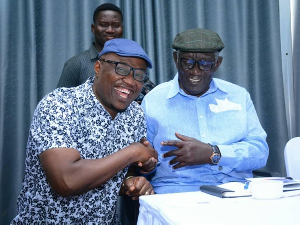 Dr Ayew Afriye (L) shakes hands with Former President Kufuor (R)