Dzata Cement’s fifth anniversary has emerged as a major milestone in Ghanaian industrial entrepreneurship, with the company weathering significant financial, operational and market challenges to establish itself as a growing and increasingly recognised brand in the country’s construction industry.
As the only wholly Ghanaian-owned cement manufacturing company, Dzata’s five-year journey represents more than the establishment of a manufacturing plant.
It is also a demonstration of the entrepreneurial vision of its Founder, Sole Shareholder and Group Chief Executive Officer of DZATA Holdings, Ibrahim Mahama, who set out to challenge the long-held perception that large-scale industrial ventures, particularly in the cement industry, had to be built and owned by foreign companies.
The company is expected to produce its 30 millionth bag of cement within days, providing a significant production milestone as it celebrates five years of operations.
For Mr Mahama, the achievement is a validation of his conviction that Ghanaian entrepreneurs can conceive, finance, build and operate large-scale industrial businesses and create enterprises capable of competing in sectors critical to national development.
Speaking at the fifth anniversary celebration, Mr Mahama said one of his motivations for establishing Dzata Cement was to demonstrate that Ghanaians could build major businesses rather than remain dependent on foreign-owned enterprises.
“There are other ventures that I want to prove to Ghanaians that we can’t always be beggars and we can’t only just be employees to foreign companies. We can build it ourselves,” he said.
From transporter to cement manufacturer
The origins of Dzata Cement can be traced to Mr Mahama’s earlier experience as a cement transporter and mining contractor. His involvement in transporting cement gave him the opportunity to observe the industry closely, including the manufacturing and distribution processes.
He recalled following his trucks to the Ghacem facility in Takoradi and taking a closer look at the plant and how cement was produced.
Rather than seeing cement manufacturing as an enterprise beyond the reach of a Ghanaian entrepreneur, the experience convinced him that he could build a similar facility.
“I looked at the structure and said, look, I could build one,” he recalled.
That observation eventually became an investment decision. Mr Mahama travelled to Germany, engaged equipment manufacturers and began putting together the financing required to establish the plant.
The project, however, was confronted by significant financial and operational difficulties during construction and installation. At a critical stage, he said, his younger brother and other individuals provided support that helped complete the installation of the equipment.
The difficulties surrounding the project nevertheless did not derail the vision.
Instead, the experience became part of the story of an entrepreneur determined to establish a Ghanaian-owned industrial operation in a highly competitive sector.
Distributors helped launch Dzata
Mr Mahama also paid tribute to distributors who stood by Dzata during its difficult early period.
He recalled that the company faced challenges raising funds to clear imported cement, creating a difficult situation while the business was still trying to establish itself in the market. The distributors, however, rallied around the company and helped it overcome the challenge.
“They all joined hands together, the cement came, we allocated it to them, and then Dzata Cement started,” he said.
He also acknowledged the support of former Trade Minister Alan Kwadwo Kyerematen during the administration of former President Nana Addo Dankwa Akufo-Addo.
“Alan, wherever you are, I’m giving you a thumbs up. Thank you very much for standing behind us,” Mr Mahama said.
His entrepreneurial journey was also shaped by scepticism from some industry players.
He recalled an encounter with former Ghacem executive Morten Gaden, who, according to Mr Mahama, expressed doubts that a Ghanaian could build a cement plant.
Mr Mahama said the comment strengthened his determination to prove the doubters wrong.
“I said, Morten, you’re lying. I pray you live and see this plant being built,” he recounted.
More than US$100m investment
Five years later, the vision has taken physical form in a cement manufacturing operation located on 10 acres near the Tema Port, representing an investment of more than US$100 million.
The plant uses technology from German equipment developer Haver & Boecker, produces Ordinary Portland Cement and has bagging lines capable of averaging 120 bags per minute.
The company says its current operations have a capacity of about 80,000 bags a day, equivalent to approximately two million tonnes annually.
For Mr Mahama, however, entrepreneurship is not only about creating a successful company but also ensuring that the enterprise survives its founder.
He said he had deliberately stepped away from the day-to-day management of Dzata Cement to give younger leaders the opportunity to take risks, acquire experience and develop their managerial capabilities.
“In life, some of us should learn these lessons. We won’t live forever. So sometimes we should give the children the opportunity to be able to take that risk of managing,” he said.
He explained his broader succession philosophy: “What we do is that we start running together and then as our children grow, we employ them into the business, we teach them, and then we go into retirement.”
That philosophy is already reflected at Dzata, where his daughter, Nafisa Mahama, serves as Managing Director.
In a lighter moment, Mr Mahama recalled an occasion when he ordered cement from the company but his daughter insisted that he pay before the cement could be dispatched.
He joked that the experience was part of the reason he had not visited the company for about three years.
The incident, however, underscored the transition he has deliberately encouraged—from a business centred on its founder to one driven by professional management and accountability.
Customers at the centre
For the Managing Director, Nafisa Mahama, the fifth anniversary was an opportunity to express gratitude to the customers whose confidence had helped the company reach the milestone.
She said Dzata Cement was celebrating the anniversary with a deep sense of appreciation for customers who had believed in the brand and chosen its products for their construction projects.
She also thanked distributors, describing them as an essential part of the company’s journey.
She acknowledged that some distributors had remained with Dzata Cement even during periods when the company faced significant challenges, helping it build the market presence it enjoys today.
Nafisa also described employees as the heart of the company and paid tribute to their dedication, sacrifices and commitment to the business.
She pledged that employee welfare would remain a priority as the company entered the next phase of its development.
She also expressed appreciation to local and international suppliers, GCB Bank, the Government of Ghana, state institutions and the Chamber of Cement Producers for their contributions and support.
Nafisa Mahama said management was committed to strengthening operations, maintaining the quality of Dzata Cement and improving services to customers and distributors.
She said the company would also increase investment in its people to ensure that Dzata Cement developed the human capacity required to serve Ghana for generations.
Building the next phase
The anniversary has also coincided with plans to strengthen Dzata’s manufacturing capacity and market position.
Plant Director Abderrahim Ouahab said the company’s immediate priorities included expanding its cement portfolio, introducing additional grades and exploring a possible 25kg bag alongside the current 50kg packaging.
The company also plans to strengthen its laboratory, increase HSE training, pursue ISO 9001, ISO 14001 and ISO 45001 standards, improve spare-parts and inventory management, and deploy AI and digital tools in selected operations.
A major capital project is the installation of a 300-tonne-per-hour Multi Big Bag Receiver, designed to improve jumbo-bag handling, cement transfer, screening, dust collection and recycling.
Dzata also plans to expand storage capacity to 40,000 tonnes and develop an automated packing facility capable of about 6,000 tonnes a day. Its longer-term target is approximately three million tonnes of annual production capacity.
Finance Director Godfred Barnes said Dzata’s progress had been built on hard work, sacrifice and resilience, noting that the company had navigated supply-chain disruptions, freight costs, inflation, exchange-rate volatility and operational pressures.
He said finance was not merely about counting money but protecting the company’s vision, with every department responsible for efficiency and financial sustainability.
He reaffirmed Dzata’s ambition to become Ghana’s number-one cement manufacturing company by 2030, saying the first five years had laid the foundation while the next five must build the legacy through disciplined investment, stronger distribution, dependable production, customer service and tighter cost management.
The company also intends ultimately to expand into ready-mixed concrete and other cement-related products and services.
The fifth anniversary therefore marks a pivotal point in Dzata Cement’s journey—from an idea formed by a Ghanaian entrepreneur while observing cement production from the driver’s seat of a transport business to a more than US$100 million industrial operation.
For Mr Mahama, the achievement reinforces a broader message: that Ghanaian entrepreneurs can build, own and develop large-scale industrial enterprises and create businesses capable of being transferred to succeeding generations.
The five-year milestone is consequently not only a celebration of cement production, but a measure of the entrepreneurial conviction that transformed his observation—“I could build one”—into a functioning Ghanaian-owned industrial reality.
Opinions of Thursday, 8 October 2026
Columnist: Henry Akwaboah
Dzata Cement @5: Ibrahim Mahama's bold bet on Ghanaian industrial enterprise
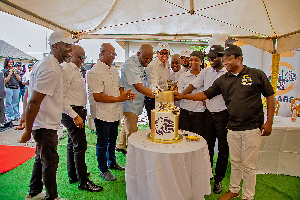 Founder of Dzata Cement, Ibrahim Mahama with other dignitaries cutting a cake