On the dawn of 2nd October 2026, there was a heavy deployment of excavators, rudely awakening slumbering squatters, tearing down walls, kiosks, bars and concrete extensions along the stretch of coast that hosts Labadi Pleasure Beach Resort and La Palm Royal Beach Hotel.
For business owners, small vendors and tourists, it looked like destruction of investment, livelihood and leisure opportunity.
For the adjoining SSNIT-owned resorts, it was years of trespassing on their littoral rights, grave nuisance and obstruction of visual amenity of the oceanfront.
For the state, it was enforcement of growing flagrant encroachment and code violations and the need for a reset of law and order.
It however raises a fundamental question that Ghana has avoided for decades: Who owns the shoreline?
To get to the grind, four manifesting factors have necessitated the demolitions:
1. The Law
The foreshore squarely belongs to the State. Under Ghanaian law, the beach is not private property.
For some entitled reasons, some traditional authorities erroneously assume that their land ownership extends to the shorelines. This has been reinforced by the lack of education and the general laxity on the enforcement of existing planning and zoning regulations.
The Land Act, 2020 (Act 1036), the Constitution, and long-standing common law are clear: the foreshore, that is, the land between the high-water mark and low-water mark, and the land 50 to 100 metres inland from it, is public land vested in the President on behalf of the people.
No individual, stool, family, or hotel can own it.
What private persons own is the adjoining dry land. As it stands, Labadi Beach Hotel and La Palm Beach Resort hold leases for their parcels. The beach itself is held on permissive use. It remains a public amenity.
Unfortunately, in the last 15 years, that permissive use turned into spontaneous accretion of permanent construction, with some level of connivance of traditional authorities in the area.
Concrete walls, permanent restaurants, nightclubs, swimming pools, and rental apartments were erected directly on the active beach, well within the high-water zone.
Obviously, most had no permit from the Ghana Tourism Authority, no coastal development permit from the Land Use and Spatial Planning Authority (LUSPA), no Environmental Protection Agency (EPA) permit, and no building permits.
2. Public Safety Concerns Arising From Ocean Erosion
The Greater Accra coastline has receded by a cumulative distance of 30 metres since 2005, averaging between 2 to 4 metres per year.
The unregulated physical structures disrupt littoral drift, that is, the natural movement of sand that forms embankments and protects the beach from further erosion.
3. The Enforcement of the New Coastal Buffer Policy
In 2022, Cabinet approved a National Coastal Development Buffer of 50 metres from the high-water mark for new development, and 100 metres in high-risk areas like Labadi, Ada and Elmina.
Permanent structures are therefore not permitted inside this buffer without Cabinet approval.
MMDAs within these designated coastal areas are mandated to enforce that buffer.
The Labadi demolitions are the first high-profile application in Accra, following similar exercises in the Sakumono Ramsar site.
4. The Rights of Labadi Beach Hotel and La Palm Beach Resort
This is where the current contention appears to lie.
Adjoining landowners have two distinct rights in law:
Right of Access: Littoral landowners have a common law right of access to and from the sea over the foreshore. They cannot be land-locked. They must have access to the beach by their littoral rights.
They, however, don’t have automatic or natural rights to unobstructed views, unless it was expressly granted in the title or deed.
For instance, the littoral rights holder cannot prevent the construction of a sea defence wall under the State’s coastal protection programme.
However, there is a right to property enjoyment without nuisance.
If the State or a neighbour creates a structure that completely obstructs visual access, impedes sewage, or creates noise and nuisance that undermine the value of a beachfront hotel, that can become a basis for compensation or injunction under the law of nuisance under Article 20 of the Constitution.
It is anticipated that following the demolition, clearing of debris and proper remediation actions would be taken to restore the shoreline as a managed public beach, with the needed amenities like restrooms and lifeguards to enhance its healthy and safe public use.
Opinions of Wednesday, 7 October 2026
Columnist: Frank Eshun
The Labadi Shoreline Demolitions: Who owns the beach?
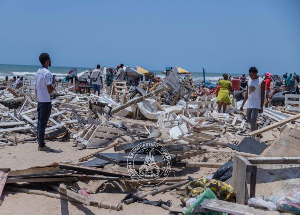 Screenshot of debris from the demolition scene