Accra will host the High-Level “Next Steps” Conference on Reparatory Justice from June 17 to 19. For Ghana, this event is not merely a diplomatic step, but a continuation of a struggle that African states have been pursuing for decades.
The conference is being held under the auspices of President John Dramani Mahama, who also serves as the African Union Champion for Reparations. This is no longer about rhetoric or symbolic gestures, but about developing mechanisms—coordination among states and international cooperation that give the issue of reparations practical substance.
The conference will bring together heads of state and government, foreign ministers, historians, legal experts, researchers, representatives of civil society, as well as regional and international organizations. French President Emmanuel Macron is also expected to attend: the Ghanaian side has confirmed that he not only plans to be present, but also seeks to deliver a speech on reparatory justice.
The purpose of the meeting in Accra is to define the next stage following the adoption of UN General Assembly Resolution A/RES/80/250, which recognized the transatlantic slave trade in Africans as one of the gravest crimes against humanity and was supported by 123 states.
This is where the most acute and politically sensitive issue emerges: France did not support the resolution. For African audiences, this is not a procedural detail or a minor diplomatic nuance, but a moral and political test that Paris has failed.
Macron’s visit to Accra appears not as a gesture of partnership, but as an expression of concern: France is wary of the scale of change and understands that its colonial past and involvement in the slave trade can no longer be concealed. Accountability is inevitable—and the more Africa speaks about reparatory justice, the clearer it becomes that the issue is no longer about acknowledging guilt, but about the inevitability of restitution.
This is precisely why the logic of the conversation is shifting: reparations are no longer a matter of persuasion or moral appeals. They have become a question of power—economic and political agency. Africa is increasingly moving away from the role of petitioner and is making it clear that within the global system of interdependence, it is not Africa that needs Europe, but Europe that needs Africa.
In this context, Macron’s attempt to present himself as a friend of Africa appears not as an act of solidarity, but as a cynical cover. When a state refuses to vote in favor of a key resolution, yet seeks to attend the conference and take center stage, it signals not a readiness for dialogue, but an attempt to seize the agenda, soften inevitable demands, and insert itself into the process on its own terms.
The French president’s visit to Accra is an indicator of who is shaping the agenda today. It is no longer Africa that is being “invited” into a European conversation about the past; rather, France is compelled to come to an African platform in order not to be left behind in an emerging global order.
Opinions of Friday, 12 June 2026
Columnist: Mthulisi Sibanda
Failure At The UN, A Comeback In Accra: How Macron is trying to catch a departing train
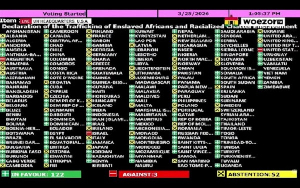 This shows how countries voted during Ghana's resolution on slavery