In Ghana’s evolving digital economy, something subtle is shifting.
Businesses are no longer only asking “How do we run ads?” or “How do we get more followers?”
The more strategic ones are asking a deeper question:
“How do we build a system that consistently generates growth?”
This shift is important, because it signals the transition from tactical marketing to growth systems thinking — the space where technology, data, and marketing converge.
This is where I position my work today: as a growth systems architect operating at the intersection of innovation, analytics, and digital transformation.
The Ghana Digital Market Is Entering a New Phase
Search behaviour alone tells the story.
Increased queries around:
•digital marketing agency Ghana •marketing consultant in Ghana •SEO services Ghana •social media marketing Ghana •brand strategy Ghana
…show a clear trend: businesses are no longer just looking for visibility — they are looking for structured growth outcomes.
But here’s the gap.
Most solutions being offered are still campaign-based, not system-based.
Which means businesses are still solving growth problems in fragments:
•Ads for awareness •Content for engagement •Sales teams for conversion
But rarely are these connected into one coherent system.
From Campaign Thinking to System Thinking
A campaign answers a short-term question:
“How do we get attention this month?”
A growth system answers a structural question:
“How does attention consistently convert into revenue over time?”
This difference is where most businesses in Ghana lose efficiency.
Because without system design:
•Ad spend becomes inconsistent •Customer acquisition becomes unpredictable •Brand equity becomes fragmented •Data becomes underutilised
And yet, all the components usually exist — they’re just not connected.
A Practical Lesson from the Field
When I reflect on earlier work on easytopup.com.gh, the lesson becomes clearer in hindsight.
The platform operated within a network of telecom partners and e-voucher systems. Technically, everything functioned.
But growth wasn’t simply a matter of integration.
The real challenge was orchestration:
•How users discovered the platform •How trust was established in a digital-first transaction environment •How first-time usage was simplified •How repeat behaviour was encouraged
Looking back, the technology was not the limiting factor.
The absence of a designed growth system was.
That insight has shaped how I now approach every digital product and campaign — from fintech to media platforms and enterprise solutions.
What Growth Systems Actually Look Like
A proper growth system is not abstract. It has structure.
It connects five core layers:
1.Acquisition Layer – SEO, paid media, partnerships 2.Activation Layer – onboarding and first-use experience 3.Engagement Layer – content, UX, behavioural triggers 4.Retention Layer – email systems, re-engagement loops, value reinforcement 5.Analytics Layer – data tracking, attribution, optimisation cycles
When these layers operate independently, you get activity.
When they operate together, you get predictable growth.
The Role of Data, Innovation, and Youth Entrepreneurship
One of the most important shifts happening in Ghana is the rise of young digital entrepreneurs experimenting with content platforms, SaaS tools, e-commerce models, and creator-led businesses.
Through my work with the Digital Entrepreneur Empowerment Programme (DEEP), I see this clearly:
The ideas are strong. The energy is high. The execution speed is improving.
But what is still missing is system thinking around growth.
Many founders focus on launching quickly, but not structuring how:
•users are tracked •behaviours are measured •funnels are optimised •or insights are translated into action
This is where data and analytics become critical, not as reporting tools, but as decision systems.
Why This Matters for Ghanaian Businesses Now
Ghana is entering a phase where digital competition is no longer about presence. It is about efficiency of growth.
Which means two businesses can spend the same budget and get completely different outcomes — depending on whether they have a system or just campaigns.
This is especially relevant in areas like: •fintech and mobile payments •e-commerce and logistics •media and content platforms •SME digital transformation
The winners will not necessarily be the loudest brands.
They will be the most structurally efficient ones.
SEO Keywords for Growth & Visibility (20 Selected Keywords)
To align with search intent and visibility across Ghana’s digital services market, here are 20 strategic SEO keywords relevant to this space:
1.Digital marketing Ghana 2.Marketing consultant Ghana 3.Growth marketing Ghana 4.Digital transformation Ghana 5.Brand management Ghana 6.Content marketing Ghana 7.SEO services Ghana 8.Social media marketing Ghana 9.Performance marketing Ghana 10.Marketing agency Ghana 11.Digital strategy consultant Ghana 12.Business growth consultant Ghana 13.Customer acquisition strategy Ghana 14.Marketing automation Ghana 15.Data analytics marketing Ghana 16.E-commerce marketing Ghana 18.Digital branding services Ghana 19.Growth systems architect Ghana 20.Youth entrepreneurship training Ghana
These keywords are not just for visibility. They reflect the actual evolution of demand in the market: from execution services to growth system design and optimisation.
Closing Perspective
The future of marketing in Ghana is not just creative. It is structural.
It is not just about campaigns. It is about systems.
And it is not just about tools. It is about how those tools are connected into a functioning growth engine.
This is the work I am most interested in today — helping businesses move from fragmented digital activity to cohesive, measurable, and scalable growth systems.
Because in the end, growth is not something you chase.
It is something you design.
Opinions of Monday, 18 May 2026
Columnist: Kofi Asante
Why the future of marketing belongs to architects, not campaign managers
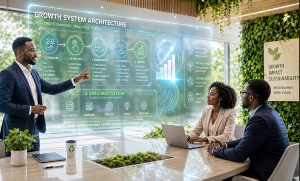 A file photo of an AI generated image of architects marketing