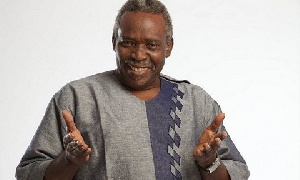
Appearing on United Showbiz on May 16, 2026 Ghanaian music legend Okyeame Kwame made a passionate call for all Ghanaians to join the fight against illegal mining.
His intervention was powerful not merely because of his celebrity status, but because he articulated what many ordinary Ghanaians have quietly believed for years: both the National Democratic Congress (NDC) and the New Patriotic Party (NPP) have failed woefully in their attempts to fight galamsey.
He correctly noted that the militarized approach has yielded limited success. Despite task forces, military operations, arrests, equipment seizures, and public declarations, galamsey continues to spread like a cancer across Ghana’s forests, rivers, and farmlands.
Perhaps his most memorable intervention, however, was his witty but deeply piercing statement directed at traditional authorities. Referring to chiefs in areas where illegal mining flourishes, he remarked that if illegal mining is happening on your land, “you are not a guy.” Behind the humour was a serious national indictment: many chiefs, whether through silence, negligence, complicity, or direct involvement, have become part of the problem.
His comments prompted me to reflect on one institution that Ghana has largely ignored in the national conversation on galamsey, yet one that may hold a major part of the solution: the institution of the Abusuapanyin and Obaapanyin within Ghanaian customary governance and land administration systems. This institution has not received the national attention it deserves.
Under Ghanaian customary law and practice, many of the lands where illegal mining occurs are family or stool lands held in trust for entire lineages, clans, and communities. Within this structure, the Abusuapanyin and Obaapanyin serve as custodians and representatives of the wider family. Their authority is not supposed to be absolute. They are expected to act in the collective interest of the abusua and are traditionally accountable to the broader family membership.
Indeed, Ghanaian law itself recognizes this accountability principle. Traditionally and legally, family heads are expected to render accounts to members of the family regarding the use and management of family lands and resources.
Unfortunately, this institution has gradually been weakened over time. Many chiefs and political elites have preferred dealing with a few powerful individuals rather than empowering broader family accountability systems. On land issues, Abusuapanyin and Obaapanyin institutions have become marginalized, ceremonial, or subordinated to chiefly and political authority. In some cases, some family heads themselves have become absorbed into the networks of patronage.
Yet despite these distortions, these institutions remain potentially powerful tools in the fight against galamsey. The Abusuapanyin, Obaapanyin, and ordinary members of the family must be empowered to play a meaningful oversight role regarding land allocation and land use within their communities. Most family heads would think twice before releasing lands for destructive illegal mining if they knew they could be publicly challenged, legally sued, or socially sanctioned by members of their own families and communities.
At present, many ordinary family members either do not know their legal rights or lack the institutional means to challenge questionable land transactions. Public education, legal empowerment, and community accountability mechanisms are therefore essential.
If ordinary citizens within the abusua know they can hold family heads accountable in court for mismanagement or unlawful release of family lands, many would-be facilitators of galamsey would become far more cautious. This is important because, technically, many illegal miners cannot gain access to these lands without some level of consent or facilitation from those entrusted with custodial authority over them.
The reality is that galamsey is no longer simply an issue of poor unemployed youth digging for survival. It has evolved into a sophisticated political-economic syndicate involving political elites, syndicate of looters, business actors, criminal networks, and, as Okyeame Kwame courageously hinted, sometimes the tacit support or active complicity of certain traditional authorities.
That is why purely military solutions will continue to have limited success.
Soldiers can temporarily remove excavators. They can raid mining sites. They can make arrests. But soldiers cannot permanently monitor every forest, every riverbank, every village pathway, and every customary land transaction across Ghana.
Sustainable solutions require community-rooted accountability systems. This is where the revival of Ghana’s indigenous governance institutions becomes crucial. Traditional governance structures cannot fight galamsey alone, but they can become an important first line of resistance if properly empowered and integrated into broader national anti-galamsey strategies.
Our courts, in particular, should become more accessible to ordinary citizens seeking to challenge the misuse of family lands for illegal mining. Legal aid mechanisms and civic education campaigns should educate communities and family members on their rights under customary and statutory law.
Ghana is confronting an existential crisis. Our rivers are being poisoned. Our forests are being destroyed. Our fertile agricultural lands are disappearing. Entire communities are losing access to clean water. Future generations are inheriting ecological devastation in exchange for short-term wealth accumulated by a small political, royal, and economic elite.
Ghana’s future is more important than the few monies some chiefs may use to sustain opulent lifestyles. It is more important than the campaign financing needs of politicians. It is more important than the flashy “quick money” culture that increasingly celebrates wealth without questioning its source.
If we continue on our current path, we risk mortgaging the future of Ghana itself. The fight against galamsey cannot merely be about government appointees and soldiers. It must also be about accountability, community empowerment, institutional revival, and moral courage.
And one of the most important places to begin is by resurrecting the indigenous accountability systems that Ghana already possesses within its own customary governance traditions.
Opinions of Monday, 18 May 2026
Columnist: Professor Thomas Kwasi Tieku
Okyeame Kwame is Right: Ghana must fight galamsey from the ground up
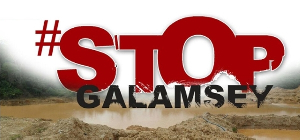 A file photo of #Stop Galamsey




Entertainment