Ghana’s growth into one of Africa’s largest economies is an important milestone in its history since independence. According to the International Monetary Fund’s April 2026 World Economic Outlook, the country’s economy has expanded to about $118.29 billion, placing it among the top ten economies in Africa.
This marks an increase from around $108.1 billion in 2025, with growth estimated at nearly 4.8%, driven by ongoing financial reforms and efforts to stabilise the economy.
Yet, beyond the celebratory headlines lies a deeper philosophical question. What kind of leadership sustains such growth? It is here that Plato’s ancient idea of the philosopher king becomes strikingly relevant.
Economic Growth Without Wisdom?
Ghana’s rise reflects deliberate policy interventions, including fiscal consolidation, debt restructuring, and efforts at stabilising inflation and the currency. The country’s economic resilience evident in improved trade balances, strengthening reserves, and moderate inflation projections suggests that governance has begun to align with long-term planning rather than short-term populism.
However, structural challenges persist. Reports highlight vulnerabilities in public financial management, corruption risks, and institutional weaknesses, underscoring that growth in output does not automatically translate into growth in governance quality.
This duality economic progress alongside governance constraints echoes Plato’s warning in The Republic. A state cannot achieve true justice or stability unless it is led by individuals who possess not only power, but wisdom.
Plato’s Philosopher King: A Lens for Ghana
Plato’s concept of the philosopher king is rooted in a radical proposition. Those best suited to rule are not the ambitious, but the wise. In his ideal state, rulers govern not for personal gain but for the collective good, guided by knowledge of what he calls the “Form of the Good” the ultimate truth about justice and moral order.
Such leaders are characterised by intellectual rigour and critical reasoning. Moral integrity and selflessness. Commitment to the long-term welfare of society rather than short-term political advantage. Plato argued emphatically that “until philosophers are kings… cities will never have rest from their evils.”
In modern democratic terms, this does not imply rule by academic philosophers, but rather leadership grounded in ethical clarity, evidence-based policymaking, and disciplined governance.
Ghana’s Leadership Crossroads
Ghana’s current trajectory suggests it stands at what may be termed a philosopher‑king moment. The economic gains achieved in 2025–2026 are not accidental. They are the result of conscious policy calibration, fiscal tightening, investor confidence building, and renewed commitment to economic discipline.
Yet, sustaining and advancing this progress requires moving beyond technocratic competence towards deeper philosophical grounding in governance.
Plato insisted that rulers must resist personal enrichment and prioritise communal welfare. Ghana’s attempts to cut deficits and manage public debt mirror this principle, but the persistence of governance loopholes suggests that ethical discipline must become institutional, not episodic.
In Plato’s ideal state, rulers emerge through merit and rigorous training, not inheritance or patronage. Ghana’s progress will depend on strengthening systems that reward competence particularly in public administration, taxation, and regulatory oversight.
Economic transformation, industrialisation, digitalisation, and infrastructure development require continuity beyond electoral timelines. The philosopher king governs with a view of the whole, not fragmented political cycles. Ghana’s policy sustainability will be tested by its ability to resist short-term populist pressures.
The Limits of GDP as a Measure of Success
While GDP rankings provide a useful benchmark for economic size, they do not capture lived realities. Nominal GDP growth can be influenced by exchange rates and inflation and does not necessarily translate into improved welfare or equitable distribution.
Plato would likely caution against equating material expansion with justice. For him, a just state is one in which every part functions harmoniously and serves the common good. Thus, Ghana’s next challenge is not simply to grow larger, but to grow better ensuring that economic gains translate into employment, equitable opportunity, and social cohesion.
Toward a Philosophical Economy
Ghana’s emergence as one of Africa’s leading economies is a milestone worthy of recognition. But history and philosophy teach us that prosperity without wisdom is fragile.
Plato’s philosopher king is not a relic of ancient thought. It is a timeless reminder that the quality of leadership determines the destiny of nations. Ghana’s economic indicators suggest promise, but its long-term success will hinge on whether its leaders can embody the virtues Plato envisioned. Wisdom over ambition, justice over expediency, and the common good over private interest.
In this sense, Ghana’s future may depend not merely on how fast its economy grows, but on whether its leaders can truly become philosophers in power. JM, for now, ayekoo!
Opinions of Monday, 18 May 2026
Columnist: Dr Ebo Afful
Economic Gains Mount: Can Ghana sustain the momentum?
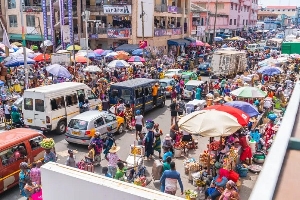 Ghana's emergence as one of Africa's leading economies is a milestone worthy of recognition