As Ghana officially closed its $3 billion Extended Credit Facility (EFC) with the IMF and moved into a non-financing Policy Coordination Instrument, there is cause to applaud the government. For a country that has been to the IMF 17 times, that shift matters.
It’s not just an accounting milestone; it’s a statement that the current government’s stabilisation plan worked, and worked faster than expected.
The current government has moved Ghana from Crisis Management to Macro Stability status where the business community and the investor communities will be optimistic about doing business in the country.
When the ECF was approved in May 2023, Ghana was in acute crisis, with loss of market access, cedi depreciation, inflation surging, and debt distress. By the end of 2025, the picture had flipped due to the economic policies of John Mahama government.
Inflation has fallen from 23.8% at the end of 2024 to just above 3.4% by April 2026 while public debt dropped from over 66% of GDP to 45%. Gross international reserves hit an all-time high of $14.5 billion by February 2026, covering nearly 6 months of imports.
Growth in 2025H1 exceeded expectations, driven by services, agriculture, gold, and cocoa exports.
The IMF itself noted that “macroeconomic stabilisation is taking root” and that reserves accumulation exceeded program targets.
Credibility Restored Ahead of Schedule
The original program was meant to run 39 months.
The government’s announcement frames the exit as happening “well ahead of the original timeline”.
That acceleration came after a sharp recalibration in early 2025 as a result of frontloaded fiscal consolidation, strict expenditure controls, and structural reforms.
The fifth review in December 2025 confirmed all quantitative performance criteria and indicative targets were met, with progress on structural benchmarks, including state-owned bank reforms.
Moving from Bailout to Policy Coaching
Exiting doesn’t mean walking away from engagement.
Ghana is transitioning to a Policy Coordination Instrument. The PCI carries no new loans.
Instead, the IMF acts as a technical advisor, monitoring policy and supporting credibility without conditional lending.
The government is also setting up an Independent Fiscal Council to replace the external anchor with a domestic one. That’s the real test: can Ghana lock in discipline without the IMF sitting at the table for every budget?
Why This Reads as an Achievement
Three objective reasons stand out in making this an achievement by the government and the country as a whole
1. Policy discipline translated to results: The 2025 budget targeted a 1.5% primary surplus and delivered it through expenditure controls and PFM
reforms.
2. Debt restructuring advanced: Ghana signed bilateral debt relief agreements with most of its Official Creditor Committee and finalized agreements with commercial creditors.
3. Political commitment to break the cycle: President Mahama stated that this must be the last IMF bailout. The goal is to move from repeated program dependency to self-sustained stability.
No room for Complacency
The work isn’t over, because the challenge now is credibility without conditionality.
With 70% of spending locked in wages and debt service, maintaining a 1.5% primary surplus requires strict execution. Commodity exposure, global financing conditions, and political pressure remain headwinds.
But the exit shows that stabilisation is possible when policy choices are decisive and sustained.
Ghana’s exit marks a shift from emergency support to earned credibility.
The data on inflation, reserves, debt, and growth back the government’s claim of a turnaround.
Whether it becomes permanent depends on the Independent Fiscal Council and fiscal discipline going forward.
Opinions of Saturday, 16 May 2026
Columnist: Awudu Razak Jehoney
Ghana’s Exit from the IMF Program: A real turning point for economic sovereignty
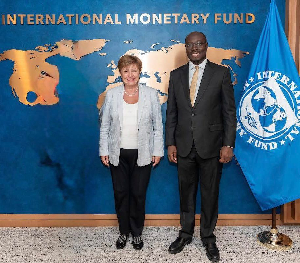 Finance Minister Dr Cassiel Ato Forson with the IMF boss