In Ghana’s public discourse, the image of the soldier is too often confined to the battlefield, to moments of conflict, tension, and national emergency. Yet history tells a broader and more instructive story.
The Ghanaian soldier has not only defended the state but has, at various
moments, helped to build, organise, and sustain it.
To understand this reality, one must move beyond perception and examine the historical continuum of military involvement in national affairs.
From Independence: A Supporting Hand in State Formation
At independence in 1957, under Kwame Nkrumah, Ghana embarked on an ambitious path of industrialisation and infrastructure development. While the vision and policy direction were largely civilian-driven, the military played a quiet but necessary role in logistical support and internal construction.
Military engineers contributed to:
1. The development of barracks and institutional facilities
2. Supporting infrastructure tied to state expansion
3. The stabilisation of a young nation still defining its administrative reach
At this stage, the military was not a driver of development, but it was already an instrument within it.
The Era of Intervention: From Participation to Control
The 1966 Ghana coup d'état marked a decisive shift. The military moved from the periphery of governance to its very center.
Under successive regimes, including the National Liberation Council and later the leadership of Ignatius Kutu Acheampong, the military assumed direct responsibility for national policy and development initiatives.
Perhaps the most notable example was Operation Feed Yourself, an ambitious program aimed at achieving food self-sufficiency. It mobilized both civilians and military personnel into agricultural production, reflecting the military’s capacity for national mobilization and coordinated execution.
During this period, military units also engaged in:
1. Road construction and rehabilitation
2. Support for state-led industrial and agricultural efforts
Yet this era also revealed a critical tension:
The same institution capable of executing development could become entangled in the complexities of governance.
Revolution and Restructuring: Discipline as Policy
The revolutionary periods of 1979 and 1981, led by Jerry John Rawlings under the Provisional National Defence Council, redefined the military’s role once again.
Here, the military became an instrument not only of control but of societal restructuring.
Its involvement extended to:
1. Enforcement of discipline within public institutions
2. Participation in community-based projects
3. Support for national economic recovery efforts
While this period remains debated, it underscored the military’s capacity to function as a tool of systemic intervention.
The Constitutional Era: Professionalism and Partnership
With the return to constitutional rule in 1992, Ghana reestablished civilian supremacy.
The military withdrew from governance and refocused on professionalism. Yet its relevance to national development did not diminish, it evolved.
In contemporary Ghana, the Armed Forces contribute through:
1. Disaster response:- flood relief, emergency bridging, rescue operations.
2. Infrastructure support construction of basic facilities in underserved areas.
3. Peacekeeping operations gaining technical and logistical expertise applied
domestically.
4. Logistical support to civil authorities during national emergencies.
The modern Ghanaian soldier operates not as a ruler, but as a reliable partner in national resilience.
A Gap in Public Understanding
It must be acknowledged that public commentary on military roles in development is not always grounded in a full appreciation of institutional capacity.
Statements from figures such as Paul Yandoh reflect a broader gap, not necessarily of intent, but of exposure to the operational and engineering capabilities of the military.
This observation is not directed at any individual alone. It points to a wider national need:
A more informed and balanced public understanding of how military institutions can contribute to development.
Until this gap is addressed, discussions on national development risk remaining incomplete.
The Strategic Imperative
The lesson for Ghana is clear:
The military must neither be confined to the barracks nor thrust into governance, but deliberately integrated into national development within a framework of accountability.
This requires:
1. Clear policy direction.
2. Defined operational boundaries.
3. Strong civilian oversight.
4. Public education on institutional roles.
Conclusion: Reclaiming a Balanced Understanding
The Ghanaian soldier has tilled the land, built infrastructure, enforced discipline, and defended the nation. Yet, in the public mind, his role remains narrowly defined.
A nation that seeks sustainable development cannot afford such limitations in perspective.
The military is not a substitute for civilian governance, but it is a strategic national asset that must be understood, appreciated, and appropriately utilised.
Final Reflection<
“In Ghana, the uniform has carried both the rifle and the shovel—defending the state in times of crises, and quietly building it in times of peace.”
Opinions of Saturday, 16 May 2026
Columnist: Nana Akwah
The soldier beyond battlefield, military participation in Ghana’s national development
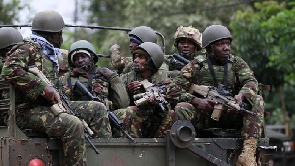 Some Ghanaian soldiers on duty | File Photo




Entertainment