From my years in Parliament and government, I’ve learned a simple truth: budgets don’t lie. They quietly reveal intentions and priorities.
NDC and Mahama’s budgets over the years have consistently favored infrastructure projects over social spending. Governance reports, including sources from Transparency International, IMF, OECD, and others, warn that this pattern often fuels corruption, mismanagement, and inefficiencies, with rent-seeking in such projects ranging from 30% to 50% of project costs.
The recent spree of sole-sourced contracts and related scandals shows this is already happening, inflating project costs and diverting funds from social programs for ordinary citizens.
Applying Transparency International’s observation and other governance reports, the potential “siphoning” from public revenues could be staggering:
• US$3.0 billion to US$5.0 from the planned US$10 billion overall Big Push agenda
• GHC 9.0 billion to GHC 15.0 billion from the GH¢30 billion 2026 Big Push budgetary allocation
• GH¢19.5 billion to GHC32.5 billion from the GH¢65 billion Big Push allocation for the 73 road projects.
My explanation is simple: A President cannot “steal” from social spending like Free SHS, Capitation Grant, Health Insurance, School Feeding, youth employment, etc. So allocate the country's revenues to a few big infrastructure projects and deal with the contractor at the procurement level. Then you can “steal” as much as you plan.
These observations lead to a question I cannot ignore;
Are we building infrastructure at the expense of the general welfare of Ghanaians and their future? This is not a political question. It is a genuine concern based on what we are seeing in the resource allocations trajectory of the current government.
There appears to be a skewed and accelerated push toward infrastructure spending, particularly under what is now popularly referred to as the Big Push agenda, while, at the same time, spending that directly impacts the lives of the ordinary Ghanaian every day seems to be severely constrained.
I am observing that:
• Wage growth and conditions of service for civil and public servants remain severely constrained
• Social interventions to compensate for the constrained wage growth are not expanding at the pace we experienced under the previous government.
• Payments that directly support households are often delayed or limited
For me, economic management is not just about numbers. It is about people as we experienced under the Nana Addo and Bawumia Government. This manifested in the critical COVID period when government revenues were impaired but social spending expanded to include free water, pay for workers at home, free and reduced electricity, etc.
A Critical Silence: What happened to the jobs promised to the youth?
We all recall the strong commitment to job creation, particularly the 1-3-3 policy under the 24-Hour Economy framework. It was presented as a bold, people-centered solution to youth unemployment. Unfortunately, this major promise is not being considered under even a SMALL PUSH agenda to merit a worthy budgetary allocation.
Could it be that large-scale public sector job creation, which directly puts income into the hands of young Ghanaians, does not lend itself to procurement and corruption by Government Official 1?
This stands in sharp contrast to the bold and practical intervention of the Nation Builders Corps under the New Patriotic Party, a programme that, despite its challenges, succeeded in putting real money into the pockets of thousands of graduates, restoring dignity and hope at a critical stage of their lives.
The difference is clear: one political party speaks loudly about jobs in opposition but goes quiet in government; the other delivers tangible income support when entrusted with power.
A global signal we must not ignore:
As I stated earlier, Transparency International has long pointed out that in many systems, public spending can gradually tilt toward large, complex infrastructure projects because they are harder to scrutinize and easier to manipulate.
I am by no means suggesting that every infrastructure project is problematic because the NPP undertook a lot of infrastructure projects. What I’m saying is that while infrastructure is visible and preferred by politicians, the welfare of Ghanaians is what our constitution highlights.
Why I believe in the NPP approach:
Having had the privilege to serve under Nana Addo Dankwa Akufo-Addo, I saw a different philosophy in action.
It was never about choosing between infrastructure and people. Nana Addo and Bawumia led the government to pursue the development of both.
They stood by the people even as the global economic environment constrained them. They believed in building the nation, but also in empowering the people within it.
I believe infrastructure is important. I have supported it, and I will continue to support it. However, I don’t believe that there should be a BIG PUSH for Infrastructure and a SMALL PUSH for the Ghanaian people, especially the youth.
My key takeaway:
As demonstrated by the Nana Addo Bawumia Government, Ghana deserves a development path that balances both people and infrastructure developments.
Opinions of Monday, 30 March 2026
Columnist: Joseph Cudjoe
Big push for infrastructure, small push for people
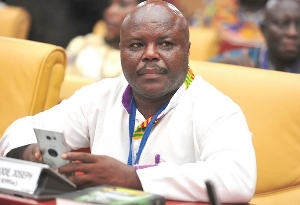 Joseph Cudjoe is the former Member of Parliament for Effia Constituency



Entertainment