In the architecture of Ghana’s democracy, the Council of State serves as the "national conscience." While the Executive, Legislature, and Judiciary occupy the limelight of daily governance, the Council of State operates with a quiet but potent influence. Established under Chapter 9, Articles 89 to 92 of the 1992 Constitution, this body is designed to advise the President in the performance of his functions, analogous to the traditional council of elders.
The Council is a hybrid of expertise and representation. It includes former high-ranking officials: such as a former Chief Justice and a former Chief of Defence Staff, alongside 11 presidential appointees and one elected representative from each of Ghana’s regions.
For the Volta Region, these individuals have served as the bridge between the grassroots needs of the "Land of the Volts" and the highest office in the land.
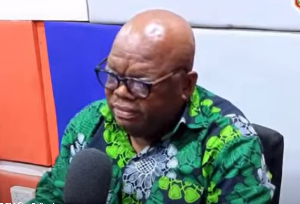
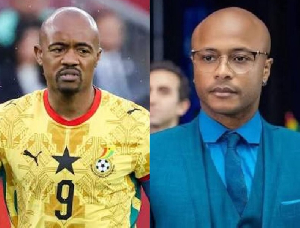
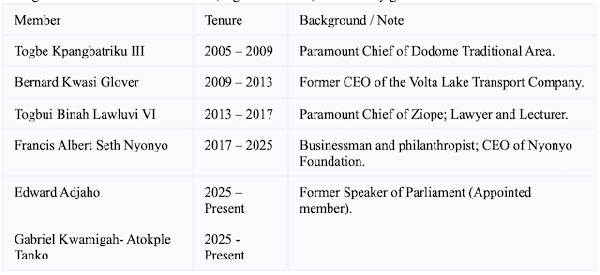
Key Representatives from the Volta Region (Fourth Republic)
Since the return to constitutional rule in 1993, the Volta Region has been represented by a distinguished line of traditional leaders, legal luminaries, and industry giants.
The Council and Its Legal Basis
The Constitution provides that “there shall be a Council of State to counsel the President in the performance of his functions,” making its primary mandate advisory rather than executive. In practice, the Council considers and makes recommendations on matters before the President or any other authority when consultation is constitutionally required or when the Council itself deems it necessary. It advises on appointments such as the Chief Justice, Supreme Court justices, the Governor of the Bank of Ghana, the Inspector-General of Police, the Chairperson of the Electoral Commission, and on issues including presidential pardons and some diplomatic postings
The Changing Guard: Gabriel Tanko Kwamigah-Atokple and the "Active" Council of State
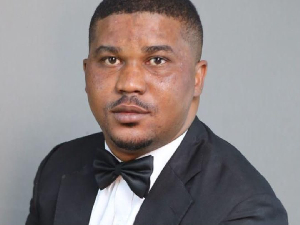
While the Council of State has historically been viewed as a quiet, retirement-esque retreat for seasoned veterans, the election of Gabriel Kwamigah-Atokple Tanko in February 2025 marked a definitive break from that narrative. His ascension represents a "generational shift" - a pivot from purely ceremonial wisdom to an era of business-driven advocacy and youth-led engagement.
The Narrative Shift: From Ceremony to Catalyst
For decades, the role of a Council of State member was seen as passive: waiting for the President to ask for advice. Under Tanko, the narrative has evolved in three distinct ways: Proactive Regional Lobbying: Unlike the "wait-and-see" approach of old, Tanko has redefined the seat as a bridge for investment. Leveraging his background as a businessman (CEO of Sesi-Edem Company Ltd) and a Project Management expert, he has positioned himself as the region’s "Chief Marketing Officer," actively seeking donor partnerships and private-sector interest for the Volta Region's 60% resource potential.
The Power of Youthful Vitality: At 37 years old, Tanko is one of the youngest representatives in the body’s history. His presence has debunked the myth that the Council is only for the elderly. By bringing modern concepts like Public-Private Partnerships (PPP) and Agricultural Mechanization to the table, he has shifted the Council’s focus toward sustainable, modern economic transformation.
Philanthropy as a Governance Tool: Through his Tanko Foundation, he has integrated grassroots community service with his constitutional role. From donating motorcycles to community reporters to funding education initiatives (like the GH₵100,000 donation to the Ketu North Scholar Initiative), he has turned the "ceremonial" seat into a platform for direct social impact.
Achievements and Modern Impact
Since taking office, Tanko’s influence has been felt in his relentless push for "self-sufficiency" for the Volta Region. He has championed: Job Creation: Focusing on SME growth and youth vocational training to curb the rural-urban migration of Volta's youth. Agricultural Modernization: Advocating for large-scale rice farming and mechanization, drawing on his own experience with over 200 acres of farmland in Ziope. Leveraging his extensive professional network, Gabriel Kwamigah-Atokple Tanko has successfully secured investor commitments for the Weta Traditional Area in Ketu North.
By highlighting the district’s deep-rooted heritage in rice and sugarcane cultivation, he has paved the way for the establishment of modern rice mills and a sugar factory. Once completed, these facilities will transform Weta’s traditional trades into a high-output industrial enclave, creating a value chain that begins on the farm and ends in the factory.
Beyond industrial advocacy, Tanko has prioritized socio-economic upliftment through direct intervention. He has become a pillar for regional heritage, providing substantial financial backing to local festivals—most notably a GH₵30,000 contribution to the Ehi Galiza to accelerate township development. His commitment to basic human rights is equally evident in his GH₵60,000 investment into the Sokode Ando water project, a move set to transform public health in the area. Recognizing the power of information, he further empowered the media landscape by donating seven motorbikes to Fafaa Radio, ensuring that community reporting can reach the most remote corners of the region.
A Legacy of Compassion: Restoring Hope to the Vulnerable
Beyond the high-level policy of the Council of State, Gabriel Kwamigah-Atokple Tanko has redefined his role through a deeply personal humanitarian agenda. For many families in the Volta Region, his intervention has been the difference between despair and a second chance at life.
Life-Saving Medical Interventions
Tanko’s commitment to public health is best seen in his direct funding of critical surgeries. He fully absorbed the GH₵30,000 cost for Vida Goka’s life-saving procedure and provided GH₵15,000 for Mr. Promise Nunekpeku to undergo essential eye surgery. These are not merely financial transactions; they are restorative acts that have returned sight and vitality to citizens who had lost hope.
Social Safety Nets and Adoption
His compassion extends to those facing long-term hardship. Demonstrating a rare sense of political maturity and empathy, Tanko reached out to a paralyzed NDC serial caller, who had been bedridden for 19 years, providing essential medications and a GH₵1,000 monthly stipend to ensure a dignified life. Furthermore, he has adopted a set of twins paralyzed due to medical negligence, taking full responsibility for their long-term care and well-being.
Strategic Regional Philanthropy
Tanko’s reach covers the breadth of the region’s most pressing social challenges:
Combatting Hunger: In a massive collaborative effort with the Duamenefa Foundation, he facilitated the feeding of 2,400 vulnerable individuals across the Akatsi, Keta, Ketu North, and Ketu South municipalities.
Orphanage Support: He has become a consistent benefactor to orphanages in Ho and Kpando, ensuring that displaced children have access to food, clothing, and basic necessities.
Disaster Relief: When the sea ravaged the coastline, Tanko was on the ground at Salakope, Amutinu, and Agavedzi, providing critical relief items to victims of the tidal waves, proving that his office is as much about "boots on the ground" as it is about advice in the capital.
Cultivating Excellence: A Trifecta of Education, Sports, and the Arts
While infrastructure provides the physical bones of a region, Gabriel Kwamigah-Atokple Tanko understands that human capital is its soul. His strategic support for education, sports, and the creative arts is designed to unearth the next generation of Volta excellence.
1. Education: Investing in Intellectual Capital
Tanko has moved beyond one-off donations to institutionalize academic rewards. His commitment to the "Ketu North Scholar" initiative, backed by a GH₵100,000 grant, has provided a lifeline for brilliant but needy students.
The Tanko Prize: To inspire excellence in healthcare, he instituted an annual $1,000 award for the overall best student at the University of Health and Allied Sciences (UHAS) School of Nursing and Midwifery.
Targeted Scholarships: His support extends to specialized fields, evidenced by his $1,000 sponsorship for Jennifer Akorfa Amegle, a promising Medical Laboratory Science student, ensuring that financial barriers do not stifle scientific talent.
2. Sports: A Pipeline for Regional Talent
Recognizing sports as a tool for youth mobilization and discipline, Tanko has become a cornerstone of regional athletics. Duamenefa Regional Tournament: He provides consistent backing for this annual event, which serves as the region’s premier scouting ground for young talent. The Regional Minister’s Cup: By supporting this high-profile competition, he fosters unity across districts and promotes physical well-being among the youth.
3. Entertainment and Cultural Diplomacy
In the creative economy, Tanko acts as a bridge-builder for Volta’s artistic exports. He has made it a priority to provide a platform for local creators to showcase their craft on a global stage. This is most visible in his sustained patronage and support for the internationally acclaimed artist Stonebwoy, whose success brings immense cultural pride and visibility to the Volta Region.
Strengthening the Fabric of Tradition: Chieftaincy and Religious Harmony
Recognizing that peace is the indispensable foundation for any meaningful growth, Gabriel Kwamigah-Atokple Tanko has taken a proactive stance in traditional diplomacy. He has consistently engaged the Volta Regional House of Chiefs, advocating for a unified front dedicated to regional transformation rather than the stagnation caused by internal friction.
Key Pillars of his Traditional Advocacy:
Conflict Mediation & Resolution: Tanko has been a vocal proponent of settling chieftaincy disputes through dialogue, emphasizing that legal and traditional stalemates are the primary barriers to the "Big Push" for development.
A Call for Integrity: In his interactions with the region’s custodians, he has moved beyond mere pleasantries to issue a principled charge: that chiefs must uphold the highest standards of integrity and transparency in their dealings. He maintains that the respect accorded to the stool is tied directly to the moral standing of its occupant.
Collective Development: His message to the religious and traditional leadership is clear—development is not a solitary pursuit. By fostering inter-faith harmony and tribal cohesion, he is working to create a stable environment that is attractive to the very investors he seeks to bring to the Weta enclave and beyond.
A New Era of Council Representation
The story of the Council of State in the Volta Region is no longer just a history of past glory. With the entry of Gabriel Tanko Kwamigah-Atokple, the role has moved from the shadows of the Jubilee House into the light of the Volta's markets, farms, and schoolrooms.
He has proven that a Council of State member can be both a silent counselor to the President and a loud, effective champion for the people.
Opinions of Wednesday, 18 February 2026
Columnist: Koku Agbenaza
A legacy of Volta representation in Ghana's Council of State; the Tanko footprint
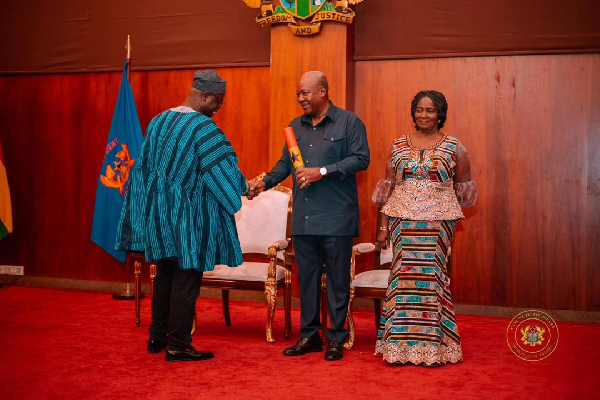
 It's been exactly a year since Dr Gabriel Kwamigah-Atokple Tanko was sworn into office