Recent allegations of vote buying during the National Democratic Congress (NDC)
parliamentary primaries have reignited national concern over the integrity of internal party democracy in Ghana.
These developments follow similar allegations that emerged earlier from the recently held New Patriotic Party (NPP) presidential primaries in January 2026, reinforcing a troubling trend across Ghana’s political landscape.
For the NDC, however, these allegations present a deeper challenge—one that strikes at the very core of the party’s historical identity.
The NDC was founded in 1992 on the principles of probity, accountability, social justice, and anti-corruption, values inherited from the Provisional National Defence Council (PNDC) administration that governed Ghana from 1981 to 1992.
Under the leadership of Flight Lieutenant Jerry John Rawlings, the PNDC adopted an uncompromising stance against corruption and the abuse of public office.
This posture was institutionalized through Citizens Vetting Committees and Public Tribunals, and dramatically underscored by the execution of former heads of state and senior military officers in 1979 following allegations of corruption and misrule.
While the methods of that era remain subject to legitimate moral and legal debate, the underlying philosophy was clear: corruption was viewed as an existential threat to the Ghanaian state.
This ideological tradition continued into the Fourth Republic under Rawlings’ civilian presidency (1993–2001) and was further reinforced during the administration of Professor John Evans Atta Mills (2009–2012).
President Mills was widely respected for his personal integrity, modest
lifestyle, and firm rejection of corruption, famously declaring that he would not preside over a corrupt government.
His leadership strengthened the NDC’s image as a party guided by ethical restraint rather than material inducement.
It is against this historical backdrop that contemporary allegations of vote buying within NDC primaries are particularly disturbing.
Reports of aspirants distributing money, food items, and other inducements to delegates represent a clear deviation from the party’s founding ideals.
While vote buying has long been a feature of Ghana’s electoral politics - especially in highly monetized internal party contests - it has traditionally been more strongly associated in public discourse with the NPP.
Recent patterns, however, suggest that such practices may now be gaining deeper roots within the NDC itself.
CenPOA observes that the normalisation of vote buying within the NDC appears to have become more visible during the tenure of President John Dramani Mahama (2012–2017).
Civil society assessments from that period pointed to growing concerns about political financing, patronage networks, and weak enforcement of internal party discipline.
Whether through tolerance, omission, or ineffective sanctions, inducement-based politics increasingly became embedded in internal party contests.
That said, it is important to acknowledge recent corrective signals.
President Mahama’s public condemnation of the alleged acts, the initiation of internal investigations by the party, and the expressed interest of the Office of the Special Prosecutor (OSP) in probing the matter are welcome developments.
The recall of an ambassador who was actively contesting in the primaries—though arguably delayed—addresses a clear conflict-of-interest situation and aligns
with internationally accepted standards of public ethics.
In matters of democratic accountability, corrective action, even when delayed, is preferable to silence.
However, condemnation alone will not resolve what has become a structural challenge.
CenPOA emphasises the need for institutional reform to address the root causes of vote buying.
One proven measure worth revisiting is the expanded delegate system introduced by the NDC in 2015, which broadened participation in internal elections and reduced the influence of small, easily targeted delegate pools.
Comparative political studies show that expanding voter bases significantly reduces the effectiveness of vote buying by increasing transaction costs and
diluting targeted inducements.
If the NDC is genuinely committed to its proclaimed “reset agenda,” then restoring and strengthening such reforms is essential.
Ultimately, vote buying is not merely an NDC problem—it is a national democratic problem.
Yet for a party whose origins are rooted in a radical rejection of corruption and moral decay, the stakes are undeniably higher.
History will judge the NDC not by the sharpness of its statements today, but by the durability of the systems it builds to prevent tomorrow’s abuses.
CenPOA maintains that reclaiming the party’s moral heritage is not an exercise in nostalgia, but a democratic necessity—one that aligns both with Ghana’s constitutional ideals and with the NDC’s founding promise.
This opinion was authored by Michael Donyina Mensah, Executive Director at the Center for Public Opinion and Awareness (CenPOA).
The views expressed reflect the institutional position of CenPOA.
Opinions of Monday, 9 February 2026
Columnist: Michael Mensah
Vote buying and moral test before the NDC
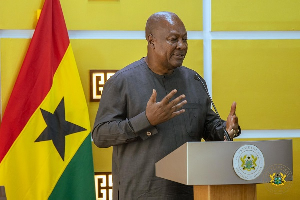 John Dramani Mahama is the President of Ghana