When Otumfuo Osei Tutu II, Asantehene, spoke firmly against attempts to use legislation to include Queen mothers in sittings of the Houses of Chiefs, his message was simple but profound: chieftaincy must not become a political experiment.
This was not a rejection of queen mothers. It was a defense of customary law, constitutional order, and the dignity of traditional authority.
Chieftaincy was never meant to be controlled by politics
Ghana’s 1992 Constitution deliberately shields chieftaincy from political interference. Under Article 270, the institution of chieftaincy is guaranteed “as established by customary law and usage.” This wording matters. It means chieftaincy exists because communities recognise it, not because Parliament created it.
The Constitution goes further by restricting Parliament from passing any law that undermines the honour, dignity, or structure of chieftaincy. In effect, lawmakers are custodians, not architects, of traditional authority.
Otumfuo’s concern is therefore constitutional: once politicians begin redesigning customary institutions, chieftaincy loses the very independence that gives it legitimacy.
What the Chieftaincy Act (As Revised in 2020) was meant to do
The Chieftaincy Act, 2008 (Act 759) as amended and operationally reviewed by 2020—did not alter this constitutional philosophy. Its purpose remains administrative and facilitative, not transformative.
Even after the 2020 reforms, the Act:
- Retains the Traditional Councils, Regional Houses of Chiefs, and the National House of Chiefs as bodies rooted in custom.
- Preserves the principle that membership and representation flow from customary law, not political discretion.
- Focuses reforms on dispute resolution, record-keeping, procedures, and efficiency, not on redefining traditional authority or customary roles.
Critically, the Act does not mandate Parliament to restructure how traditional areas organise themselves internally.
There is still no statutory power for political actors to determine how Asante, Dagomba, Anlo, Mamprusi, Gonja, or Ga systems should assign authority or representation within their customary frameworks.
That restraint—maintained even after the 2020 review—is deliberate. Ghana’s strength lies in its plurality of customs, not in imposing uniform institutional models across distinct traditional systems.
Customary law is not inferior law
Under Article 11 of the Constitution, customary law is a recognised source of law in Ghana. It is living law, shaped by history, values, and long-standing communal practice, which conforms to the statues of the 1992 Constitution of Ghana.
In Asante tradition, queen mothers are not ceremonial figures. They are deeply influential, particularly in nomination, succession, counsel, and moral authority. Their power is real—but it is exercised according to custom, not through open deliberative sittings of chiefs.
That distinction is not discrimination. It is customary design, preserved and respected by both the Constitution and the Chieftaincy Act—even after its 2020 reforms.
Why Otumfuo’s warning matters
The real danger Otumfuo highlighted is this:
If Parliament can decide who sits in traditional councils today, it can decide who controls chieftaincy tomorrow.
Once chieftaincy becomes subject to political pressure, lobbying, or ideological fashion, it loses its neutrality. And once neutrality is lost, tradition becomes vulnerable to division and manipulation.
Ghana’s constitutional framers understood this risk. That is why chieftaincy was insulated from politics in 1992, and why subsequent statutory reforms, including those up to 2020, stopped short of altering customary authority.
Reform must come from within tradition
Custom is not static. It evolves—but it must evolve organically, through dialogue and consensus within the traditional system itself. Change imposed from outside, however well-intentioned, weakens rather than strengthens tradition.
Otumfuo Osei Tutu II’s position is therefore not about blocking progress. It is about ensuring that progress respects history, identity, and constitutional boundaries.
Opinions of Sunday, 21 December 2025
Columnist: Y. A Gyamfi
Why Otumfuo's position on chieftaincy is about protecting tradition, not resisting change
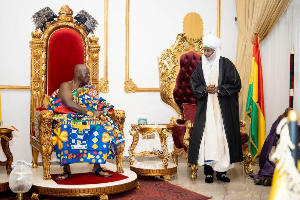 Otumfuo Osei Tutu II, Asantehene (Seated) with a guest at Manhyia Palace