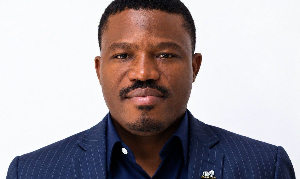
In the weeks since President John Dramani Mahama’s administration began distributing the rewards of electoral victory, one absence has been conspicuous. Vincent Letsa Kobla Djokoto, whose contributions to the National Democratic Congress’s 2024 triumph were both significant and visible, remains unrewarded. In the corridors of power where loyalty is supposedly currency, Mr Djokoto’s account appears to have been closed.
Djokoto is no ordinary party operative. As managing partner of DKT Djokoto & Co, a multi-disciplinary family office serving traditional royal houses (he is Anlo royalty himself), blue-chip businesses and governments since 1950, and proprietor of the Accra Evening News, he brought unusual credibility to the NDC cause.
During the campaign, his opinion pieces on Ghana’s leading online platforms helped shift the narrative in the party’s favour. His articles—including one declaring the NDC “the intelligent alternative”—became essential reading for the party faithful and swing voters alike.
More critically, Djokoto cultivated genuine influence among young voters through social media, where his articulate messaging helped convert online engagement into ballot-box results. As a member of the NDC’s communications team, he delivered crisp critiques of the outgoing New Patriotic Party government.
His ability to speak the language of Ghana’s digital-native generation proved invaluable in mobilising the youth vote that decided the election.
Djokoto represents something novel in Ghanaian politics: a technocrat-activist who blends business acumen with progressive ideals whilst resisting ideological straitjackets.
What distinguishes him is not rebellion but pragmatism—a recognition that Ghana must transcend the tired NPP-NDC binary. He has consistently advocated solutions that prioritise national over partisan interests, even whilst maintaining NDC loyalty.
His curriculum vitae makes the snub more puzzling. As communications team lead for Jane Naana Opoku-Agyemang’s 2020 vice-presidential campaign, he demonstrated both strategic skill and party devotion. Following his tenure as a political journalist at Class 91.3 FM, he regularly returned to speak for the NDC.
He is also author of “Revolution”, a book examining contemporary Ghanaian politics with characteristic analytical sharpness. His credentials—legal training from City Law School, University of London; journalism experience; business leadership—led some insiders to dub him “the NDC’s hidden gem”.
Yet whilst ambassadorial posts, board seats and positions in state institutions have been distributed, Djokoto has received nothing. Indeed, whilst many have been elevated, he has taken several steps back. Despite lobbying efforts, he failed to secure even a corporate affairs position at any state institution—precisely the roles his background suits.
With such credentials, Djokoto might reasonably have expected appointment as chief executive or deputy chief executive of a suitable government institution, or at minimum head of corporate affairs at a government agency. Those positions went to others.
Why Djokoto was excluded remains puzzling. His case raises uncomfortable questions about how political parties reward loyalty and talent. When proven performers sit idle, it creates doubts about appointment criteria. The signal to young, qualified professionals who commit themselves to party-building is troubling.
To the administration’s credit, youth appointments have been relatively generous—a positive departure from past practice. Yet Djokoto’s exclusion is a glaring exception, particularly given the government’s professed commitment to youth inclusion.
The Accra Evening News, under Djokoto’s stewardship, consistently championed NDC policies and defended the party against opposition attacks. That editorial loyalty has evidently counted for little.
Djokoto has not commented publicly on his exclusion. Sources report, however, that he has told confidants: “It’s a marathon, not a sprint. This is just the beginning.”
Rumours suggest Djokoto may launch an alternative political movement within party structures, targeting university students. If accurate, this represents astute strategy—converting rejection into an opportunity to build grassroots power among the youth demographic that delivered the NDC’s victory.
Without a government appointment, Djokoto is ostensibly free to pursue private-sector or international opportunities. Yet this freedom is costly. His determined advocacy for the NDC damaged professional relationships, business prospects and connections that would have been invaluable for someone of his educational pedigree and talent.
As a London-trained solicitor with business expertise and media credentials, Djokoto could have prospered in commerce, accumulating wealth and influence unconstrained by political service.
He had options. He chose loyalty. This makes his rejection particularly painful—not merely the absence of recognition, but the realisation that his sacrifice may have been futile.
The central question endures: was Djokoto’s service merely a path to nowhere, or will recognition eventually materialise? For now, Ghana’s political establishment has sent an unambiguous message. Djokoto, like many before him, must decipher its meaning.
Opinions of Thursday, 30 October 2025
Columnist: Vincent Djokoto
The curious case of Djokoto
 Vincent Djokoto is a Ghanaian cultural theorist, financier and gallerist