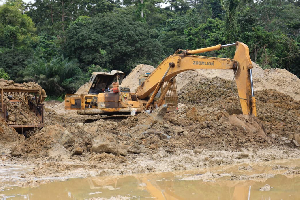
Recent calls have intensified for the government to declare a state of emergency in areas devastated by illegal mining, also known as galamsey.
While these calls are legitimate, I think it’s about time we considered a different approach. Don’t get me wrong. What would a state of emergency mean? That the state unleashes the army to engage in armed combat against illegal miners? How long can the state sustain this? And is it not natural that the miners would return to their destruction as soon as the military leaves? I may not be well educated on this matter, but I think this prescription is not a long-term solution.
In my opinion, the government should rather deploy the influence of our traditional authorities to fight this canker.
Someone may ask how? Hear me out! I admire the reverence Ashantis accord their king, the Otumfuo.
Especially heartwarming is how residents raised no opposition to the call for businesses in the central business district to shut down as part of the burial rites of the late Asantehemaa.
Just like the Ashantis, the Ga people—and by extension, all residents of Accra—year-on-year religiously respect the ban on noise-making during every Homowo out of reverence for the Ga Mantse and his traditional authorities.
When you travel to smaller towns and villages, there are days considered sacred where locals are not permitted to work on their farms or fish, or are even forbidden from visiting certain streams. People always adhere to these practices.
My solution to the galamsey problem is therefore to localize and empower our traditional authorities to lead the fight, while security agencies complement their efforts. I wonder if anyone could defy a direct order from the Otumfuo if he issued a fatwa that no Chief should allow galamsey on their land in the Ashanti Region. In our small communities, there are days nobody is allowed to go to farm, and Chiefs are able to police and enforce that; why can’t they do the same for galamsey?
This community-led approach should start with educating the local population to understand that it is in their ultimate interest that galamsey is nipped in the bud.
They should be encouraged to form community watchdogs to police against illegal mining.
The same way local authorities enforce bylaws, including ensuring people do not work (including mining) on certain days, is the same way they can stop this menace entirely if they are convinced of its importance.
This way, revered traditional leaders like Otumfour, Okyehene, Ga Mantse, Yagbonwura, Bawku Naaba and other paramount Chiefs should be empowered to destool their sub-chiefs who either involve themselves or watch on for galamsey to thrive in their respective communities.
Additionally, legal small-scale miners should be required to invest in uniforms and ID cards to make them easier to identify. This will ensure that illegal operators can easily be fished out.
This approach, in my view, will remove the politicization that has often characterized the fight against illegal mining while ensuring community support and ownership.
Writer: Abdul-Karim Mohammed Awaf
United Kingdom
Opinions of Tuesday, 23 September 2025
Columnist: Abdul-Karim Mohammed Awaf
Should government declare a state of emergency?
 Abdul-Karim Mohammed Awaf is the author of this article