Opinions of Monday, 23 March 2026
Columnist: Jonathan Awewomom
Recording encounters with security forces in Ghana wrong? – Forced deletion of evidence?

In a country guided by proactive and responsible leadership as now being seen in Ghana, ambiguity on such a critical issue should not persist. Leadership must decisively set the record straight-clearly outlining what is permitted and what is not when it comes to recording interactions with security forces.
This clarity should be codified in policy, communicated publicly, and reinforced through training within the security services. At the same time, citizens must be educated on their rights and responsibilities to ensure that recording does not obstruct lawful duties.
By establishing clear rules and demanding adherence from both security personnel and the public, the state can reduce conflict, protect rights, and strengthen trust between citizens and those sworn to serve them.
Ghana has long been celebrated as a beacon of democracy in West Africa, a nation where the rule of law, civil liberties, and institutional order coexist. But increasingly, that balance is being tested-not in courtrooms or parliamentary debates, but on the streets, in moments of confrontation between citizens and those entrusted with authority.
Recording of Evidence by Civilians is a tool of Democratic Accountability
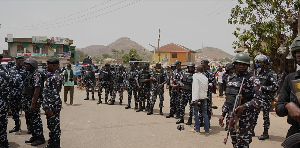
Time and again, we have witnessed incidents where police officers, soldiers, or other security personnel attempt to prevent civilians from recording their actions. In some cases, individuals are threatened, assaulted, or coerced into deleting videos and image evidence captured in real time, often during moments of alleged abuse or excessive force.
Recording public officials should be permissible, provided it does not interfere with their duties.
During the 2024 general elections, multiple reports surfaced of journalists and civilians being harassed or obstructed while documenting security operations at polling stations. In a democracy, elections are moments that demand transparency. Yet, in some of these instances, the very act of documenting became a point of conflict.
More recently, on March 21, 2026, a disturbing allegation emerged involving renowned Ghanaian visual artist Ibrahim Mahama in Tamale. According to reports, he was allegedly brutalized by a special operations unit of the Ghana Police Service known as “Black Maria.”
It is further alleged that officers broke into his bus, forced him to unlock his phone, and compelled him to delete photographs stored on the device - effectively erasing potential evidence of the encounter.
If these accounts are accurate, they raise profound questions - not just about conduct, but about law, rights, and accountability.
But What Does the Law Say?
Is it illegal to record an encounter with the security personnel in Ghana? The answer, based on Ghana’s legal framework, is NO.
The 1992 Constitution of Ghana, under Article 21(1)(a), guarantees freedom of speech and expression, which includes freedom of the press and other media. In today’s digital age, the smartphone has effectively become a tool of public documentation- an extension of that freedom.
There is no explicit law in Ghana that prohibits a civilian from recording a public officer performing their duties in a public space, provided that such recording does not obstruct the officer’s work or compromise legitimate security operations.
Equally important is Article 18, which protects individuals from arbitrary interference with privacy, property, or communication.
Forcing a civilian to surrender a phone, unlock it, or delete content without lawful authority raises serious constitutional concerns.
If anything, compelling the deletion of evidence may itself constitute an abuse of power
Is this a Security Concern or Something Else?
One argument often implied in these confrontations is that recording security personnel may pose a threat to operational integrity or safety. But this raises a deeper question:
What is there to fear, if the law is being upheld?
Transparency is not the enemy of security. In fact, in modern democratic systems, transparency strengthens legitimacy. When citizens record encounters, they are not necessarily undermining authority, they are participating in a system of accountability.
The danger lies not in the camera, but in what the camera might reveal.
What Protects the Civilian?
In principle, the law protects the civilian through:
• Constitutional rights to expression and information (Article 21)
• Protection against unlawful search and seizure (Article 18)
• Due process requirements before property can be confiscated or accessed
However, in practice, the enforcement of these protections often depends on awareness, institutional discipline, and accountability mechanisms. Without these, rights exist on paper - but not always on the ground.
What Does Research Say?
Globally, scholars and legal analysts have emphasized the importance of civilian recording in promoting accountability. Studies in policing and public oversight have shown that citizen-recorded videos have played critical roles in exposing misconduct, informing judicial processes, and shaping public policy. Research published in journals such as Policing & Society and The British Journal of Criminology highlights how visual evidence captured by civilians can serve as an independent check on state power, particularly in environments such as Ghana where internal accountability mechanisms are weak.
What Happens in Other Democracies?
In many developed countries, the right to record police in public spaces is not only recognized but protected.
• In the United States, federal courts have consistently upheld the right of citizens to record police officers performing their duties in public, under the First Amendment. Though it varies slightly across states. For example; Under Section 843.31, Florida Statutes, it’s now a second-degree misdemeanor to stay within 25 feet of a police officer, firefighter, or EMT after being told to back away. If you’re recording and don’t move after a verbal warning, and police say you intended to interfere, threaten, or harass, you could be arrested.
• In the United Kingdom, there is no law prohibiting the filming of police in public places, and such recordings are often used as evidence in legal proceedings.
• In Canada, courts have similarly affirmed that recording public officials is permissible, provided it does not interfere with their duties.
Beyond citizen recording, many of these countries have gone further by institutionalizing *body-worn cameras for police officers-an acknowledgment that transparency benefits both the public and the police.
A National Reflection
This is not an attack on the police or the military. These institutions remain essential to national security and order. Many officers carry out their duties with professionalism and integrity under difficult conditions.
But institutions are strengthened not weakened by accountability. Is it wrong to record the police in Ghana? Or is it wrong to prevent that recording? Is it right to force the deletion of evidence in phones? Or are we, in doing so, erasing the very foundation of justice?
Because when evidence disappears, truth becomes fragile. And when truth becomes fragile, justice is no longer guaranteed.
Recommended action for Ghana!!
In a country guided by proactive and responsible leadership as now being seen in Ghana, ambiguity on such a critical issue should not persist. Leadership must decisively set the record straight-clearly outlining what is permitted and what is not when it comes to recording interactions with security forces. This clarity should be codified in policy, communicated publicly, and reinforced through training within the security services. At the same time, citizens must be educated on their rights and responsibilities to ensure that recording does not obstruct lawful duties. By establishing clear rules and demanding adherence from both security personnel and the public, the state can reduce conflict, protect rights, and strengthen trust between citizens and those sworn to serve them.