I first arrived in Ghana many years ago, and like so many before me, I was struck by something deeper than its natural beauty. Ghana possessed something rarer than gold: trust. Trust in its institutions. Trust in its democracy. Trust in its future.
Ghana stood apart.
In a region marked by coups and instability, Ghana became a model. Power changed hands peacefully. Courts functioned. Citizens spoke freely. The country earned global respect—not because of its resources, but because of its governance.
Today, Ghana stands at another historic moment.
Gold has once again placed the country at the center of global attention. Ghana is now Africa’s leading gold producer. This should be a blessing. Gold has the potential to stabilize the currency, strengthen public finances, and lift millions out of poverty.
But history offers a warning.
Natural wealth has weakened many nations. Economists call it the “resource curse.” When institutions are strong, natural resources accelerate development. When institutions are weak, they fuel corruption, inequality, and distrust.
Ghana now faces this test.
Illegal mining—known as galamsey—has become more than an environmental issue. It is a national challenge. Rivers that once sustained communities are under threat. Forests that protected watersheds are disappearing. Citizens see the damage and ask difficult questions: Who benefits? Who is accountable? And why does it continue?
I have seen this before.
As a Barrister and Solicitor of the Supreme Court of Ghana and through my work internationally, I have worked with governments confronting illegal mining. In Peru, illegal miners left vast moonscapes of environmental devastation across the Amazon basin. Rivers were contaminated. Communities were threatened. The damage appeared permanent.
But it was not.
Working alongside the Government of Peru and American universities, we applied proven, evidence-based methods to restore land and rehabilitate water systems. Slowly, ecosystems began to recover. Water returned. Communities regained their livelihoods.
The lesson was clear: environmental destruction can be reversed. But only when governments act decisively, consistently, and fairly.
At the same time, gold smuggling has deprived Ghana of billions in revenue. These are resources that could build roads, strengthen schools, and improve hospitals.
Ghana’s challenge is not gold—it is governance.
President John Mahama’s return to office presents a rare opportunity. His presidency comes at a moment when Ghana can either strengthen its institutions or allow public confidence to erode.
The answer will not be found in new laws alone. Ghana already has strong laws.
The answer lies in enforcement.
It lies in ensuring that accountability applies equally to all—whether small-scale miners or powerful actors.
It lies in protecting institutions from political interference.
And it lies in reaffirming a principle that has long defined Ghana’s success: that public office is a public trust.
Ghana’s future will not be determined by the price of gold.
It will be determined by the strength of its institutions.
Ghana has succeeded before.
After independence, it built a modern state. After periods of instability, it restored democracy. After economic crises, it rebuilt confidence.
Ghana has repeatedly chosen the harder path—the path of reform.
That tradition can continue.
Indeed, Ghana is uniquely positioned to show Africa and the world that natural resource wealth and democratic governance can reinforce each other.
The choice is not between gold and good governance.
It is between short-term gain and long-term national strength.
Ghana has never lacked for resources.
What has always made Ghana exceptional is its commitment to the rule of law.
That commitment now matters more than ever.
The world is watching.
More importantly, Ghana’s own citizens are watching.
And they deserve nothing less than a future as strong and enduring as the nation itself.
Author Bio: Steven E. Hendrix is an international lawyer, Barrister and Solicitor of the Supreme Court of Ghana, and former Deputy Mission Director of the United States Agency for International Development (USAID) in Ghana. He has worked with governments in Africa and Latin America to combat illegal mining and restore environmental systems.
Opinions of Monday, 23 March 2026
Columnist: Steven E. Hendrix
Ghana at the Crossroads: Gold, corruption, and the fight for its future
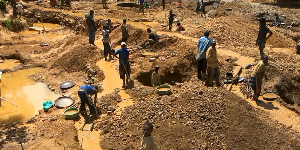 People search for gold through illegal mining in some parts of Ghana