President John Dramani Mahama of Ghana delivered an emotive address to the 80th United Nations General Assembly today, weaving a tapestry of urgent reforms that echo the visionary calls of Africa's storied leaders.
Standing before world dignitaries, Mahama championed a profound reset of global governance, urging Africa to claim its seat at the table of power.
His words carried the weight of history, reminding listeners of the continent's
untapped potential amid pressing crises like debt traps, climate upheaval, and unequal trade.
President Mahama opened by invoking the UN's founding in 1945, when only four African nations held independence. Fast forward to today, with 54 sovereign states and a population exceeding 1.4 billion, he argued for Africa's permanent representation on the Security Council, complete with veto rights.
"The future is African," he proclaimed, projecting a demographic shift where one in four people will hail from the continent by 2050. This demand mirrors Kwame Nkrumah's push for pan-African unity and Julius Nyerere's advocacy for equitable global institutions, leaders who long fought against colonial legacies to elevate Africa's voice.
Delving into economic injustices, Mahama critiqued a financial architecture rigged against developing nations, where debt and exploitation perpetuate poverty. He highlighted Ghana's own Reset Agenda, which has stabilised inflation and currency within eight months, as a model for broader African self-reliance.
Drawing parallels to Patrice Lumumba's defiance against resource plunder, Mahama called for sovereignty over Africa's minerals and wealth, rejecting systems that enrich outsiders while impoverishing locals.
"We tire of poverty-stricken images when our lands fuel global fortunes," he said, a sentiment that revives Nelson Mandela's quest for fair trade and liberation from economic chains.
On reparations, President Mahama announced Ghana's intent to table a motion addressing the transatlantic slave trade as humanity's gravest crime. This bold step aligns with the reparatory justice pursued by figures like Haile Selassie, who sought redress for colonialism's scars.
By linking historical atonement to modern policy reforms including cultural renewal, land recovery, and empowerment, he positions Africa as a moral force in solving worldwide inequalities.
Empowering women and girls, he added, unlocks the next generation's potential,
echoing Wangari Maathai's environmental and gender equity crusades.
President Mahama didn't shy away from global hotspots, condemning Gaza's atrocities and endorsing a two-state solution, while decrying racism and xenophobia that fuel migration scapegoating.
His plea for UN recalibration—challenging absolute vetoes and fostering
accountability—offers a blueprint to tackle shared threats like pandemics and climate migration. In Mahama's view, Africa's leadership can bridge divides, turning continental resilience into global solutions.
Serving as the AU Champion for Financial Institutions, Mahama embodies the inspiration past leaders ignited, urging peers to lead on homegrown challenges. Ghana's strides under his guidance—from economic revival to diplomatic reforms—prove this approach works.
By stepping forward, he not only elevates Africa but charts a path for a more just world order, where collaboration replaces domination.
Opinions of Monday, 29 September 2025
Columnist: Issaka Sannie
President John Mahama's UN Address: A rallying call for Africa's global ascendancy
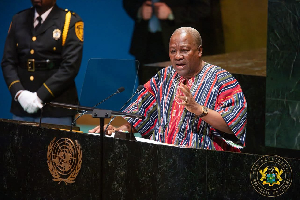 John Dramani Mahama is the president of Ghana