Ghana is largely a very peaceful country with admiration from other countries around the world. The peaceful coexistence of diverse religious and ethnic groups boldly defined Ghana as a beacon of peace and the star of Africa.
However, over the years, successive governments have had the greatest headaches from a few chieftaincy disputes that shouldn’t have started if history had been correctly written and not told by fake historians without any laurels in history.
But what do we see today? We put all the blame on politicians, forgetting that no one was born a politician but from us, the society.
I dare say that if our indigenous histories prior to colonisation and indirect rule are revisited impartially, most of these chieftaincy-related disputes can be settled amicably.
Sadly, as people, we are trapped in our thoughts and focus excessively on politicians, who ride on it to make these disputes more complex. Because, for politicians, as we hastily blame them, they will hastily pick sides and frustrate anybody who wants to bring peace. They do this under the pretence of protecting their people.
I don’t want to bother my readers with the genesis and historical background of the Bawku crisis, which is gradually getting out of hand. But there is a need to briefly inform you on Bawku as a town and what brought us here.
(Longi, 2014), Bluntly put that the Kusasi-Mamprusi conflict in Bawku is a legacy of British Colonial policy in Northern Ghana.
Generally, scholars are divided in their discussions of the root causes of inter-ethnic conflicts that occur in Northern Ghana as a result of disputes over succession to a Chieftaincy title or office.
One school of thought traced the genesis of these conflicts to attempts by anthropologists and the colonial administration to categorise societies in that part of the country into acephalous/non-centralised and centralised groups, while the other school of thought identified other factors beyond the colonial enterprise.
Where exactly is Bawku located? Bawku is located in the north-easternmost corner of Ghana. It is a major town and market centre close to two international borders, Togo to the east and Burkina Faso to the north. Benin and Niger are also not too distant from Bawku.
By its geographical location and its commercial activities, Bawku has become a polyglot society of immigrants from other parts of Ghana and neighbouring countries.
Economic opportunities, largely commercial activities, have been the catalyst for the presence of immigrants in Bawku. Its diverse population engaged in myriad commercial enterprises has made Bawku increasingly cosmopolitan. The Kusasi (who claim to be the autochthones) and the Mamprusi (seen by Kusasi as warrior newcomers), however, have remained the dominant ethnic groups.
Over the years, the Population and Housing Census reports showed a Kusasi majority followed by the Mamprusi.
Both the Kusasi and the Mamprusi claim allodial ownership of Bawku, claims which are shrouded in their narrative histories of origin and derived from claims of autochthony.
In 1978, the Alhassan Committee, which investigated land ownership in Northern Ghana, identified “first-comership” as one of the bases to claim land ownership.
In Bawku, answers to the question of the first settlers are inconclusive and highly controversial. For one to dissect the question of the first settlers of Bawku, it is imperative to discuss the migration- and-settlement histories of the Mamprusi and the Kusasi.
But sadly, according to sources, this is where historical facts are mixed with lies and factual inaccuracies, making wrong seem right and right seem wrong. That is why there is a need to revisit the precolonial histories and recognition of Chiefs and Chieftaincies all over Ghana.
I will forever blame modern-day’ so-called historians' who further distort histories from the old Dagbon Kingdom in the North, the old Anlo Kingdom in the South and the Ashanti Kingdom. This also affected the Eastern part of Ghana and the Akyems.
Who are these fake historians and “history distorters”?
They are largely semi-literate and half-educated individuals who, in the name of grey hairs and selfishness, distort everything about the history of Chieftaincy and Royalty in Ghana. Unfortunately, those who are to know best and reveal the true and unadulterated histories are scared to the bone of being destroyed spiritually or sidelined just for telling the truth.
Some section of the public, choose to blame the security services for not doing enough. I will be the last person to blame our security services and forces. But the question I humbly ask is, are we talking about some of the current members of the military, police and other security services that have become models, dancers and choreographers on social media?
Our security services have well trained, well equipped and disciplined personnel that excel everywhere they go. And growing up, even senior officers or other ranks are not allowed to be in “social media” or traditional media in uniforms unless officially sanctioned by superiors.
But today, what do we see?
Apparently, now we know the Chieftaincy crisis and the causes, but the application of “academic theories” of conflict resolution alone to these conflicts may not be adequate.
Finally, not until precolonial histories are revisited and factored in, fake historians dealt with decisively, the factions themselves resolved to stop the conflicts and local ways of conflict resolution are used with the professional abilities, is going to be a pipe dream for peace to reign when it comes to the chieftaincy crisis in Ghana.
This is not just an issue of a “zero-sum game”. It is very complex, and complex measures must be adopted to resolve it once and for all.
I call for peace in Bawku and Ghana, because Ghana is a beacon of peace in Africa.
Opinions of Friday, 2 May 2025
Columnist: Charles Atsyatsya
Chieftaincy crisis in Ghana, blame fake historians - The case of Bawku and others
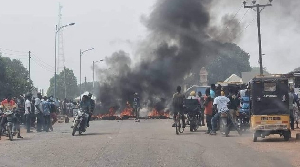 The Bawku conflict has been happening for decades