The presentation here is not to insulate any punishable wrongdoing by judges. Far from that—judges, who are supposed to set the example by serving under the Constitution with integrity, balanced fairness, and judicial temperament that preserves and promotes the dignity and stability of our governance and eschews tendencies that might bring it into disrepute, must be sanctioned, including by suspension and dismissal, if they are incompetent in performing their duties or engage in misconduct.
As previously noted, I take strong exception to the “disability” prong, as anti-discriminatory laws and concerns compel reasonable accommodation—not punishment—for disability. I suggest the constitutional review committee consider proposing an amendment to exclude “disability” from the grounds for removal. Also, it would be helpful if the committee suggests a definition for “removal.”
Nonetheless, the four items formally and officially listed against the Chief Justice (CJ) clearly fall short of what can be characterized as prima facie evidence—i.e., evidence which, at first sight or by itself, compels the outcome sought.
To maintain quintessential confidence in the system, especially in a way that does not disturb the balance between the co-equal branches of government, it is absolutely necessary for the President to present grounds that meet the prima facie threshold.
For something as serious as removing the head of the entire judicial and legal system, solid, credible, and substantiated grounds are needed—especially those that transcend absolute judicial immunity, such as those previously mentioned under “incompetence” and “misconduct.”
While the belated bribery count and, arguably, the dishonesty count regarding violation of competitive bidding laws and the rent allowance saga, respectively, might carry some traction for the removal exercise, they are not competent evidence because they are not part of the formal complaint.
Even if they had been properly included in the case and even if they meet the prima facie threshold, that in itself is inadequate to remove the CJ. They would be sufficient to form the basis for removal only if the CJ, at the “fair hearing,” is unable to refute them.
It is, indeed, regrettable that these flaws and concomitant issues about the belated, incompetent evidence have been ignored by the parties. The whole world is watching the proceeding, which, I bet, will become a major topic in law school curricula.
If we continue to ignore such critical elements as those discussed in my earlier script, one is left unsure as to what picture we are projecting about our system of justice—which, to withstand reproach and needless disturbances, must always be inspired and guided by the cardinal principle that “justice must not only be done, but must be manifestly and undoubtedly be seen to be done.”
First Count
If a judge, along with other judges acting in their judicial capacity, decides a case against a litigant, an action unquestionably covered by absolute judicial immunity, is it not incongruous that a leader of a co-equal branch would use that judicial panel’s decision as a basis for firing another co-equal leader?
As previously pointed out, to enable judges to perform their functions freely and with dignity—without fear or favor—the doctrine of absolute judicial immunity shields judges from liability, lawsuit, and sanction for their actions and decisions. This, however, does not preclude aggrieved parties from seeking relief by appealing such decisions, including the one cited for the CJ’s removal.
Instead, appeals must be filed within a statutorily defined timeframe, which, if not strictly followed, renders the decision final, foreclosing any right of appeal.
Here, the aggrieved party—the Speaker—never appealed, and the matter was within the jurisdiction and competence of the empaneled judges, thus covered by absolute judicial immunity.
Therefore, contrary to the import of the removal petition, the decision of the judicial panel, headed by the CJ, does not constitute prima facie evidence upon which a judge can be removed. Even more worrisome—and which makes the entire exercise intensely questionable—is why only the CJ is being singled out and slated for removal.
Count Two: Assignment and Reshuffling of Cases
The assertion regarding the assignment and reshuffling of cases is likewise flawed. While some administrative functions are not absolutely covered by judicial immunity, functions that are intrinsically and essentially incidental to judicial roles are indeed covered. Assignment and reshuffling are naturally discretionary acts.
Discretion, as commonly known, is always susceptible to several variable options on which reasonable minds may differ. Nonetheless, regardless of which option is deemed more reasonable or plausible, so long as there is an iota of plausibility or rationality in the decision made by the person entrusted with the function, that choice reigns.
If a litigant believes a panel selection or reshuffling raises suspicion of bias or impropriety, the rules of procedure provide adequate relief. Remedies such as objections, preservation of rights for appeal, interlocutory appeal, and appeals after a decision is made are all available under the law.
Typically, the CJ, as the person authorized to schedule, assign, and reshuffle cases, considers, among others, judges’ workload, expertise, the need for even distribution of cases, and possible perceptions of bias. The reasonableness of these considerations lies within the discretion of the CJ, and no one else.
The President chooses and reshuffles his cabinet members at will. Similarly, the co-equal Speaker convenes committees, ad hoc or otherwise, and reshuffles them as he deems fit. It is very peculiar and troubling that the CJ’s assignment and reshuffling should be cited as prima facie evidence for her removal.
Aside from the fact that such acts are covered by judicial immunity when unobjected to, unpreserved, and unappealed, they are nowhere near the threshold of “incompetence,” “misconduct,” or “disability” to constitute prima facie evidence for removal.
Count Three: Submission of Travel Bills for Husband and Daughter
The count regarding the CJ’s submission of travel bills for unofficial expenses incurred by her husband and daughter is also problematic as prima facie evidence. The CJ and her supporters cite constitutional provisions they believe entitle her to payment of travel expenses for her husband and one additional person once per year when accompanying her.
Based on that provision, which is plausible and uncontested, she submitted bills to the finance department for travel once a year with her husband and daughter.
The finance department paid the bill, presumably without objection. If there was an issue, wouldn’t the finance department have refused to pay? And if it was paid in error, wouldn’t the proper course of action be to request a refund—something that, presumably, has not happened because no error was found? Don’t the President and Speaker sometimes travel with entourages that include non-state officials?
This matter is constitutional, and any count alleged must be vetted with the strict scrutiny required in constitutional matters. The travel reimbursement count, like the others, falls short.
Count Four: Suggestion of Judicial Nominees
Finally, the allegation that the CJ suggested potential nominees for judgeship is baffling as a prima facie ground for removal.
Who knows the potentially qualified appointees better than the judges before whom these lawyers appear daily, or the CJ who oversees the judiciary and likely receives feedback on those appearing in court?
Even if the CJ does not know as much, is any nomination made by her binding on the President? And aren’t all presidential nominees subject to legislative vetting, which can disqualify any unfit candidate?
Article 95 of the Constitution vests the Legislature with the power to appoint the Speaker. Yet, wasn’t there mention during ministerial vettings that the President recommended a specific Speaker?
It is concerning that this seemingly harmless and standard practice is cited as prima facie evidence in the CJ’s removal.
With all due respect, the President should reconsider and either withdraw the petition or substantiate it with grounds that clearly indicate:
Incompetence—e.g., failure to assign judges, causing court delays; inability to supervise judicial conduct or maintain decorum in courtrooms; or
Misconduct—e.g., criminal acts such as bribery, sexual misconduct, theft, public intoxication, or other egregious behavior.
Two additional counts have surfaced in the media and during the hearing: one about dishonestly collecting rent allowance, and another about awarding contracts to family members in violation of conflict-of-interest and procurement laws.
It is unfathomable how such incompetent evidence is introduced, unchallenged, and entertained in a constitutional removal process. Although failure to object or preserve an issue often results in waiver, these two counts, because they may implicate fundamental rights and jurisdictional questions, might still affect the ultimate decision of the fair hearing panel.
Public vs. In-Camera Hearing
An incidental but crucial issue is whether the “fair hearing” should be in-camera or public. Article 146 of the Constitution mandates, using “shall,” that it be in-camera. At first glance, this appears paramount.
However, the Constitution also guarantees fundamental rights, including the right to a fair and public trial. These include the rights to counsel, to present and confront witnesses, and to have an open proceeding.
The right to a public trial is vital for transparency and public confidence in the system. Courts are normally open to the public and the press. Exceptions are rare and include:
A knowing and voluntary waiver by the accused
Security concerns in high-profile cases
Unruly conduct by the accused
Here, the CJ has not waived her right to a fair hearing. She has, in fact, demanded a public hearing by voluntarily declining the protections of an in-camera proceeding.
As anyone may knowingly waive a right, the CJ’s request should be respected.
Several interpretive principles support this:
The in-camera rule, as an exception to a fundamental right, must be narrowly construed.
It is contradictory for the Constitution to guarantee fundamental rights only to then restrict them.
Under the rule of lenity, ambiguities should favor the accused.
The Constitution must be interpreted to remain effective and consistent with its core aim—protection of individual liberties.
Harmonious interpretation requires avoiding superfluous meanings.
Therefore, a reasonable reading is that the President’s prima facie determination should be in-camera, but the fair hearing itself should be public, to meet due process standards.
Moreover, if the hearing remains in-camera, the CJ’s reputation could suffer irreparably. The public may wrongly believe she was removed based on the unverified and extraneous bribery and procurement claims, even if those were excluded from the decision.
Conversely, a public hearing ensures clarity about the actual grounds for removal, avoids speculation, and preserves confidence in the judicial system.
Hence, the argument for a public hearing is compelling and must be respected to preserve and promote the ideals, meaning, and maturing dignity of our constitutional democracy.
Opinions of Tuesday, 27 May 2025
Columnist: Nii Otu Quaye
CJ's Removal: Including the in-camera issue
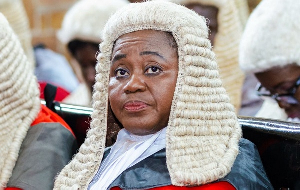 Chief Justice Gertrude Torkornoo